

How To Tell What Kind Of Sks You Have
China has been manufacturing SKS for over fifty years producing more SKS than any other nation. During this menstruum, we've seen how it has evolved from the original design to the many variations. The chief driving strength for the changes was purely economics, a need to produce more at a lower cost. Faced with an over supply in a saturated North American market, several new variants were created and marketed.
Writing this sticky was a daunting task considering the amount of information was overwhelming. Just the factory codes alone numbered in 150. Some of the codes were difficult to decipher because they were like jig-saw puzzles fitted within a triangle. I've decided to cover two of the most common Chinese SKS in Canada , the standard and a variant. The SKS-D is a distant second.
As with the Russian SKS sticky, information on how to operate a SKS is at the lesser of the report.
I don't pretend to exist an adept and this report isn't chiselled in rock. There is alot more information yet to be gathered. Should you accept information that is unlike or relevant to this study, so please mail it. There is ane thing I have learnt with the Chinese SKS is to never to say never because anything is possible, there are plenty of anomalies.
Please use this report as a guide only.
-----------------------------------------------------------------------
2.HISTORYCommunist china was embroiled in a bitter civil war that began in 1927. The fighting continued in spite of the Japanese
invasion during WWII, it finally concluded in 1949 when the Communist defeated the Nationalist who fled to the island of Taiwan.October 1st, 1949 was the birth of a new nation, the People'southward Republic of Communist china (Mainland china). It had picayune fourth dimension to rebuild when they were drawn into some other state of war the following yr. When China entered the Korean State of war in back up of her communist neighbor, her army was withal equipped with captured WWII Japanese, American and Nationalist built rifles along with donated Russian small artillery. The huge stockpile chop-chop dwindled by the cease of the state of war and they were resupplied with Russian surplus.
In 1956, when Russian federation concluded production of the SKS at the Tula Arsenal, they shipped the toolings, spare parts and specification to China along with technical advisors, who helped prepare up the manufacturing and grooming of the Chinese workers at Jianshe Arsenal (aka factory 26).
While the SKS no longer met Russia'south new standard of modern warfare, China on the other hand embraced it, China liked it for its simplicity, ruggedness and ease of operation past its newest recruits.
China felt the SKS had a part to play aslope of the AK47. In boxing, it didn't use every bit much ammo, information technology was faster to charge 10 rounds and it could provide cover fire while the AK xxx round mags were being reloaded. The SKS having a longer butt was more likely to hit the target than the shorter barrel AK.
China adopted both the SKS and the AK47 in 1956.
The spirit of cooperation betwixt the 2 Communist superpowers didn't last, it ended a few years after in 1960.
---------------------------------------------------------------------
3. VIETNAM WAR.China was an ally of N Vietnam, some other Communist neighbor. Unlike the Korean State of war she did not transport troops to fight but she did supply nutrient, equipment and weapons. China was the leading provider of small arms to North Vietnam and the war had a big impact on her production.
If there was ever a major state of war that the Chinese SKS was recognized to have played a significant supporting office, this would be the state of war.
The American public outset encountered the Chinese SKS when the soldiers brought them back from the jungles of Vietnam. Information technology soon became a popular war gift. The bringbacks as they were chosen, could fetch as much as $1000 with proper documentation. The majority of all the bringbacks were from Prc and nearly were built in Jianshe Arsenal.
----------------------------------------------------------------------
four. JIANSHE ARSENAL. Aka manufactory 26.China did not have a long history of firearms manufacturing. The oldest manufacturing plant was Jianshe and it was congenital in 1889 during the Majestic Dynasty in the metropolis of Chongqing.
Prior to the arrival of the SKS in 1956, Jianshe was producing bolt action rifles.
By the 60s, Jianshe became the largest SKS producer. China decided to further aggrandize product past adding more factories. The majority of these factories were small and they were scattered throughout the country to aid the local economies. I'm not quite sure how many factories were actually built but probably far less than the 150 known manufactory codes. Most of these factories used more than one code.
eg: factory 26=126=136=296, factory 36=386, factory 96=9616.
The late 70s to early 80s was a period of doubtfulness for Jianshe. The Vietnam war ended several years earlier, Chairman Mao had passed away, New leadership was more focussed on economical reform than with building bigger armies.
The writing was on the wall for this nearly 100 yr quondam factory. Its fate was decided when the Ground forces dropped the SKS and the AK from its front line. Information technology was replaced by the newly designed Type 81 rifle. However, other branches of the military: the militia, edge guards, honour guards and security police force connected to utilise them as second line weapons.
Today, the SKS is mainly used by the honor guards, troops on parade and for training by militias and cadets.
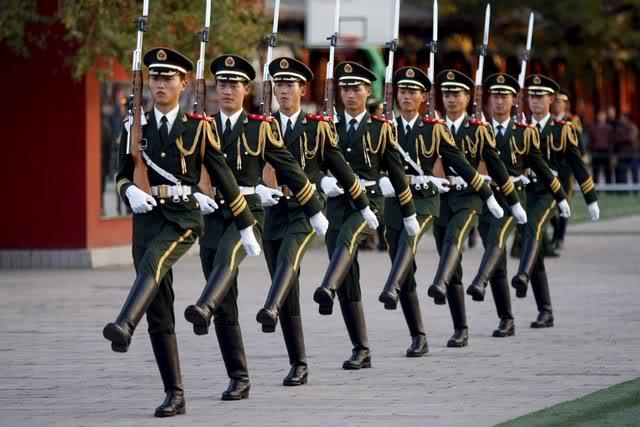
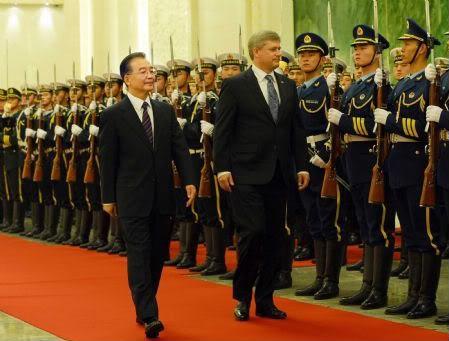
Prc'south Premier Wen Jiabao and Canada'south Prime Government minister Stephen Harper audit honor guards.
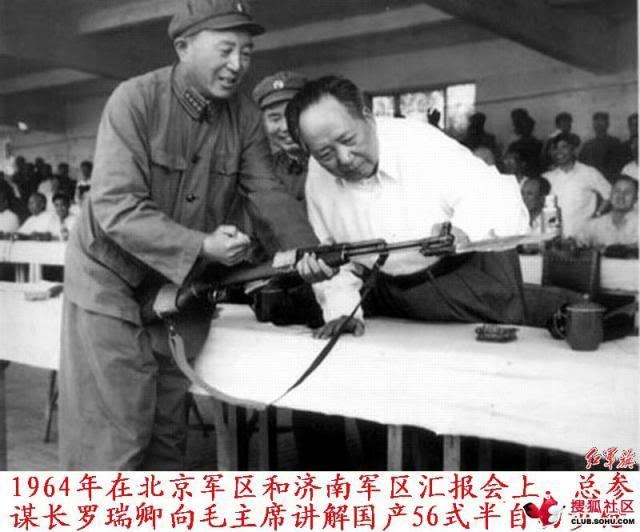
Chairman Mao takes a closer look at Jianshe in 1964.
If Chairman Mao were alive today, he would not recognize the factory that began as an Imperial artillery manufacturer because it is at present one of the meridian motorcycle, ATV and moped manufacturers in Mainland china. With joint venture partner Yamaha, they sold over 14 million units since converting in 1982.
I bet Mao never imagined the mill he once toured would one twenty-four hour period be producing consumer products that are shipped around the globe, would be in partnership with a Japanese corporation, no longer wholely owned by the land and listed on a stock exchange. Times sure accept changed.
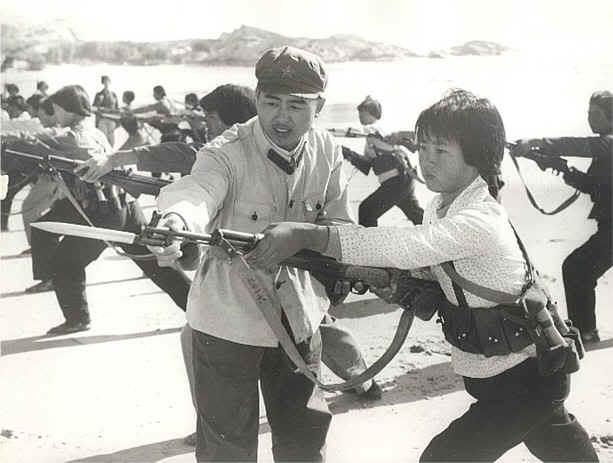
The past, daughter grooming with a rifle congenital in Jianshe.

The present, girl sitting on ATV congenital in Jianshe.
Nevertheless, Jianshe Manufacture Ltd. hasn't quite completely abandoned its legacy as information technology still develops pocket-size arms in partnership with Norinco and the PLA.
--------------------------------------------------------------------------
5. PRIMARY IDENTIFICATION. Left side of receiver. This is what a left side of the receiver from factory 26 looks similar, built in 1965.
Factory lawmaking, iii Chinese characters and series numbers (9 one thousand thousand).
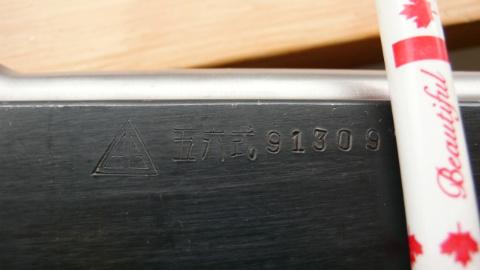
a. Mill code.
Each factory was assigned a set up of numbers (some had more than one), the older codes were within a triangle / \ while the newer codes were within a rectangle [ ] or an oblong ( ) . They eventually dropped the codes altogether and replaced them with the exporter'southward name.
-List of factory codes: The following codes are some of the 150 factory codes. I'm but listing the ones that I have seen pictures of and the pictures are from various sources. Some are from members of this and other forums and some are from various gun auction sites. This listing will exist updated when new information is received.
-Triangle codes:
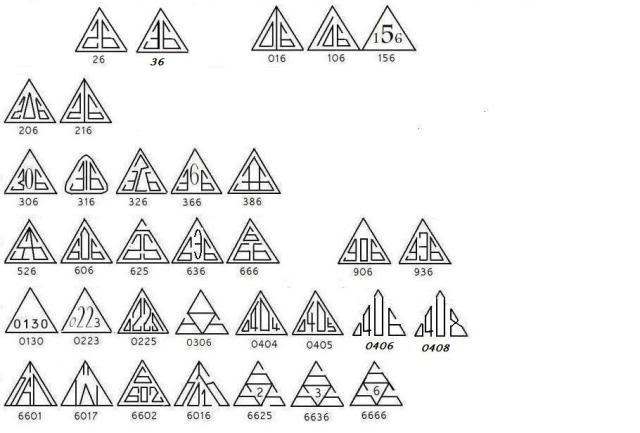
-Foursquare codes:
[0129],[0134],[0136],[0138],[0140],[0141],[0144],[0146],[0147],[0148],[0221],[0223],[0224],[0303],[0306],[6615].
-Oblong codes:
(23),(874),(965),(974),(9186),(9696).
-Diamond codes:
<0205>,<0216>
-Plain codes:
M8, M21 No, M21 0296, 416M21, DB, DP.
b. Location of the codes:
- Manufactory 26 1956-1961, the codes are located on the right side of the serial numbers.
eg:123456 /26\
- Mill 26 1962-1970, 1979-1980, the codes are on the far left side before the 3 Chinese grapheme.
eg: /26\ *** 12345678
- Other factories
Triangle code, Nearly are located on the left, before the 3 Chinese character merely a very few codes are located on the correct.
Foursquare code, can be found either before or after the three Chinese characters.
c. three Chinese characters ***.
Translates to Type 56 carbine, non to be confused with Type 56 rifle which was assigned to the AK47.
Location of the 3 Chinese characters:
- Factory 26, from 1956-1961, had no Chinese characters .
eg: 1234567 /26\ .
- Manufactory 26, from 1962-1970 and 1979-1980, located between the factory code and the serial numbers.
eg: /26\ *** 12,345,678 .
- Other factories. Most had the 3 Chinese characters are between the code and serial numbers (as to a higher place) but a few factories had only the codes and series numbers, no Chinese character.
eg: /636\ ane,234,567
annotation: At mill 26 information on 1971-1978 are non bachelor at this time.
d. The absent-minded of date of product.
Jianshe used to mark dates on their rifles prior to the inflow of the SKS but for some reason they did not on the SKS.
due east. Serial numbers.
Chinese series numbers are generally numeric, except for the first year at factory 26 where two styles of serial numbering were used.
- Russian style (early on 1956). While under Russian supervision, it was only natural the Russian advisors would implement the Russian mode of serial numbering on the Chinese built SKS. They basically followed the Russian fashion but instead of using 2 cyrillic letters followed past 4 numbers, they used 1 alfa letter followed past iv numbers. On a few rare occasions an unrecognizable symbol was observed in place of the alfa letter.
This early first year production is better known every bit Sino-Soviet SKS.
eg early 1956: A1234 /26\
- Chinese way. Quondam in the latter part of 1956, the style was switched to the Chinese. This led me to believe the Russian Advisors didn't stay in Communist china for very long. The serial number independent 5 to 6 numbers. Every yr thereafter it began at the next million, eventually to 24 one thousand thousand at manufacturing plant 26. I take seen higher at other factories.
eg late 1956: 12345 /26\ or 123456 /26\
eg 1957 to 1980: 1234567 /26\ to /26\***24000000
- Partial serial numbers located on parts:
Early and mid production: On carrier, bolt, top cover, mag, trigger baby-sit and buttstock.
Late production: On carrier and bolt.
------------------------------------------------------------------------
6. TRANSLATING THE SERIAL NUMBERS TO Product Engagement. a. Production date in serial number- Commercial variant.
Some commercial production have the production yr in the serial numbers. These ones take no manufacturing plant codes (nfc) and serial numbers of 7 digits. Serial numbers began with 88 and later. The earlier series numbers have no space while the afterwards ones take a space between the kickoff two and the concluding five digits.
eg: 8812345= 1988 , 02 12345= 2002
b. For manufactory 26.
Serial number in the millions plus the yr of adoption (1956) equal the year of production.
eg:
(<1,000,000 = 0) 0+1956=1956
(2,000,000= ii) two+1956=1958
(x,000,000 = 10) 10+1956=1966
(24,000,000 = 24) 24+1956=1980
c. For other factories.
The in a higher place formula will piece of work on another factory codes but not all of them. I cannot be certain that your result will be admittedly correct but information technology's ameliorate than not giving you a solution at all.
I would suggest that you try information technology on your SKS with a triangle, rectangle or oblong codes which has eight digit serial numbers (ignore importer'southward prefix and suffix numbers). Information technology will not work with 7 digit serial numbers. Use it in conjunction with the production classes below and meet what you come upwardly with.
-------------------------------------------------------------------------
7. SECONDARY IDENTIFICATION. Production nomenclature.
China has been building SKS for a very long fourth dimension, besides long to take just two classes like we did with the Russian SKS. It was more appropriate that we use 3: early, mid and late product classes.
The menstruum for these production classes are crude estimates. I can't expect with that many factories involved to practice things in unison, these factories were spread throught out the state and some of them were in remote areas. I am confident with the menstruation for the early production form and that is because information technology was based on ane factory, mill 26.
The quickest way we can decide this is to await at the expanse where the barrel meets the receiver.
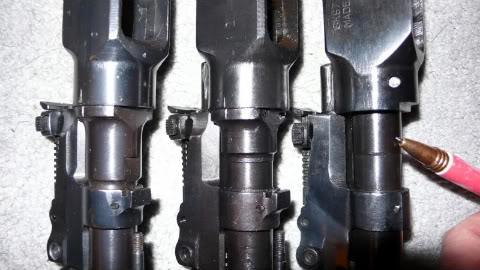
from the left:
Early production-long butt lug (1956 - part1965).
mid production- brusk barrel lug (part1965 - 1980).
late product- no lug, pinned barrel (70s - present).
--------------------------------------------------------------------------
8. SECONDARY IDENTIFICATION. Other parts.One-time in 1965. As the war in Vietnam began to escalate. People's republic of china who supplied North Vietnam with majority of her small arms embarked on a programme to brand their SKS faster and cheaper. Upward to this point they fabricated the SKS exactly like the Russian SKS (except for the forest), even in the quality. This may surprise those of you who e'er associated annihilation congenital in China as inferior.
The early on Chinese SKS was not a cheap rifle to produce, many parts including the receiver required milling. They experimented making the receiver out of postage stamp sheet metal. Production was limited, probably due to the fact that the results weren't up to their expectations. However they had much better success with the following changes.
At factory 26, Sometime in 1965, the beginning few changes were made to the bayo, stock and barrel lug. They changed the bayo from blade to a spike. It was cheaper to make a fasten from a rod. The spike was fabricated longer for better reach but likewise potent enough that the VC used information technology as a monopod. The disadvantage was it was heavier. To first this weight gain, they reduced the length of the barrel lug. Manifestly, the stock had to be inverse to accommodate for the longer bayo.
The location of the rear swivel was moved sometime in 1966, from the side to the bottom of the barrel while other factories either left them or moved information technology later. This was not a change in price savings.
In 1967, the employ of sheet metal appeared in the trigger grouping. Stamp sheet metal is cheaper and faster to produce. No skilled machinist was needed. In gild to farther reduce the dependency on milling, they eliminated the lightening cuts on the bolt carrier and the bayo lug, sacrificing a bit of the weight proceeds.
At other factories. The biggest savings in cost came when they went from threaded barrel to a pinned butt. With a pinned butt there was no demand to have a barrel lug therefore the barrel bare was alot smaller in diameter and thus cheaper. It also saved on labour considering no threading was needed, not just on the barrel simply also on the receiver. All they had to do is heat, press and pin.
IMHO, all of the above changes had no sick effect on the operation or the accuracy of the rifle. Stamped parts were still interchangeable with milled parts.
Parts ID. From front to the back of the burglarize.
a. Bayo.
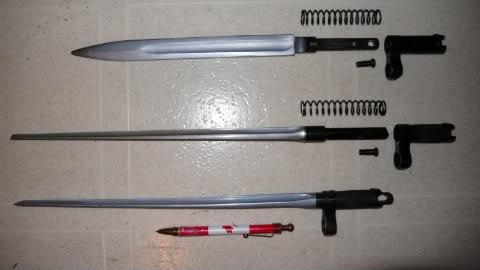
From the top: Bract, spike and spike with quick release handle for SKS-D/1000.
b. Bayo lug.
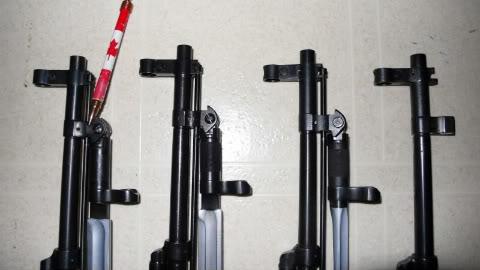
From the left: With lightening cut, no lightening cut with spiral, no lightening cut with rivet and incomplete lug for SKS-M.
c. Butt.
All Chinese SKS came with chrome lined diameter merely the sleeping room were non all chromed, chromed sleeping room came after.
d. Gas tube.
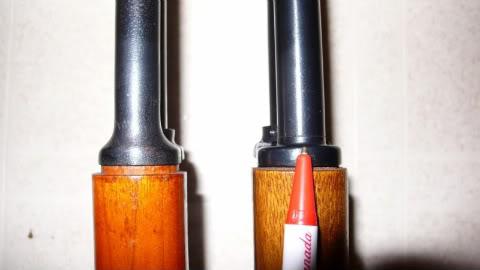
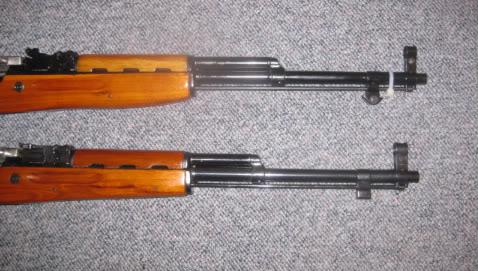
Above moving picture. from left: one piece, ii pieces. Right pic, top tube- regular length, bottom tube- short length for some D/Thou. Pic from 7.62Nato.
e. Top handguard.
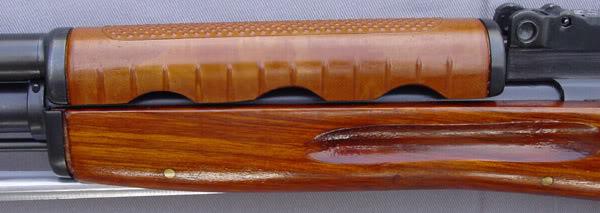
In a higher place pic from beachgumwithagun: bakelite, others are normally fabricated of wood.
f. Rear sight leaf. Markings on the leaf.
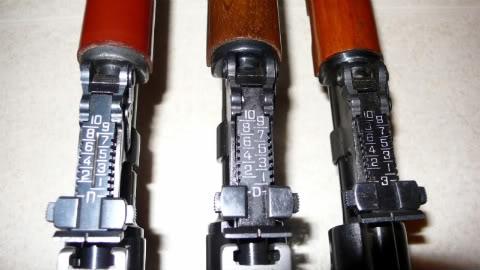
From the left: north,D,3 and III is missing.
one thousand. Rear sight base.
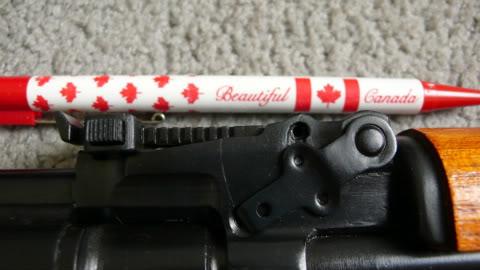
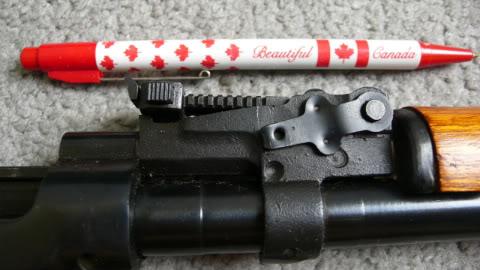
From left: early and late.
h. Carrier.
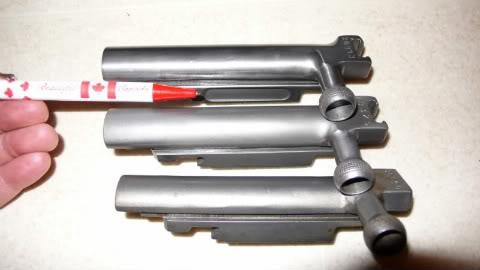
From the top: with lightening cut, no lightening cutting, no charging clip groove for SKS-D/M.
i. Bolt.
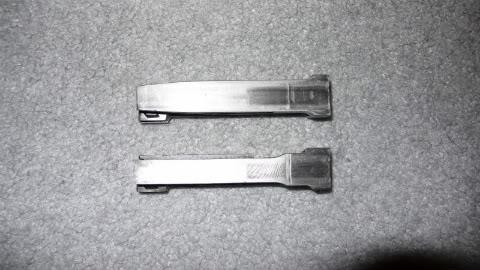
From the peak: standard, modified for SKS-D/1000.
j. Firing pin.
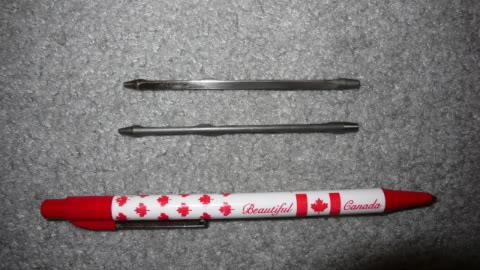
From the top: milled 3 sides (early), milled 2 sides (mid and late).
k. Master spring guide and locking cap.
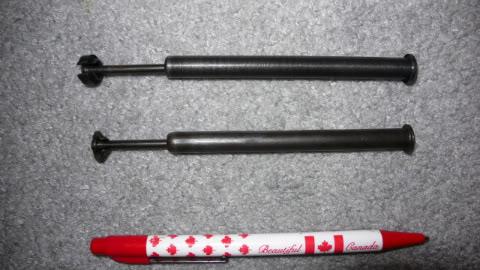
From the meridian: milled locking cap, stamp locking cap.
l. Magazine.
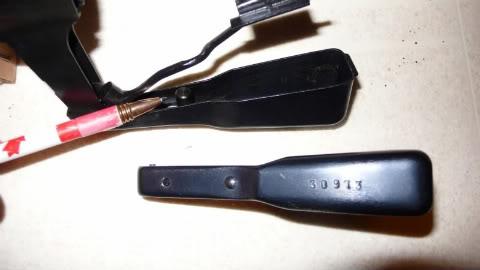
A small slice of the stud protrude through the bottom, it does not touch on the serial numbers. This is far superior to the frankken pin mags.
m. Accept downwards lever.
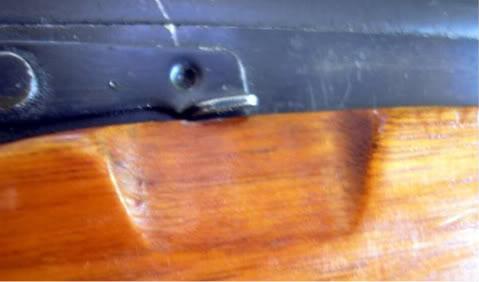
Above flick from martin08: tab at the bottom, others are ordinarily on top.
n. Trigger group.
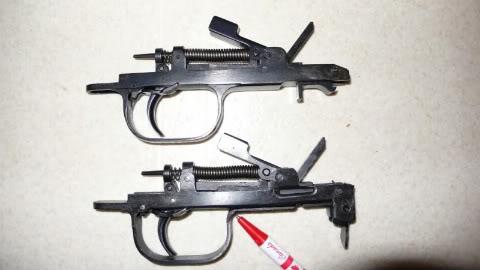
From the top: milled (early and mid production) , stamp (mid and late production).
o. Wood stock.
Made from the Catalpa tree.
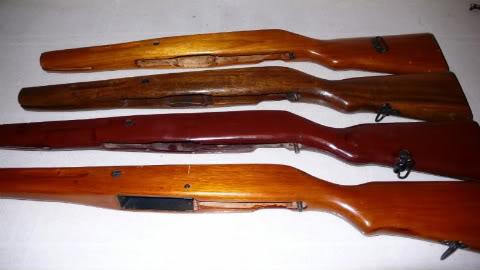
From the top: standard blade with side swivel, standard blade with bottom swivel, reddish fiberglass with bottom swivel, stock for SKS-D/One thousand.
- SKS-D/Yard wood stock.
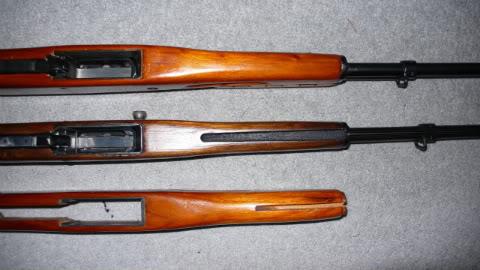
From the peak: with no cut for bayo, cut for a spike, cut for a blade.
p. Butt plate.
pic is coming.
-----------------------------------------------------------------------
ix. Manufactory 26 parts changes.
Changes made in 1965.
-Barrel, long lug 1956 - part1965, brusque lug part1965 - 1980. no pivot barrel.
-Bayonet, blade, 1956 - part1965, spike bayo part 1965-1980.
-Wood stock, for bract 1956 - part1965, spike bayo part1965 - 1978, spike with accept down lever cut 1979-1980.
Changes made in 1967.
-Bayonet lug, lightening cut 1956 - part1967 and 1979 - 1980, no lightening cutting part1967 - 1970.
-Gas tube, 1 piece 1956 - 1967, 2 pieces 1967 - 1980.
-Carrier, lightening cut 1956 -1967, no lightening cutting 1967 - 1980.
-Chief spring guide and locking cap, milled 1956 -1967, postage 1967 - 1980.
Changes made in other years.
-Rear hinge, side1956 - part1966, bottom swivel part1966 -1980.
-Pinnacle handguard, wood 1956 - 1970, bakelite 1979 - 1980.
Note: At factory 26 information on 1971-1978 are not available at this time.
------------------------------------------------------------------------
10. REFURBISH.China did not marker their refurbs. The quality of the refurb work can vary widely, Some were done actually well and others were done poorly.
Some parts were replaced with whatsoever was available at the time. No thought was given to whether it was the incorrect product grade. Nothing went to waste.
Only through observation could you tell the difference.
eg: different finish, poorly done refurb volition have grinding and filing marks.
--------------------------------------------------------------------------
11. OTHER STANDARD SKS - PLA.a. Sino Soviet. Characteristic: unique serial number and a tiny star stamp on the right side of the butt stock.
If the Russian SKS 1949 is the first year product and then the Chinese counterpart would be the Sino Soviet, except its isn't as rare equally the Russian 1949.
b. Laurels baby-sit SKS. Feature : chrome
-------------------------------------------------------------------------
12. OTHER STANDARD SKS - NON PLA. a. DP
b. Eqyptian, feature: laminated stock, blued carrier.
c. Vietnamese: marker M21 No
-------------------------------------------------------------------------
13. VARIANTS.a. Type 63. In the early years, y'all can tell Red china favoured the SKS over the AK. When it came time to develop a new rifle, they basically took the best features from the AK and married it with the SKS. Their offspring Type 63 had no significant parts that were interchangeable with the parents other than the exterior resemblance to the SKS. The internal mechanisms were completely different. The Blazon 63 had a rotating locking bolt, an adjustable gas regulator, selective fire and information technology also use a detachable mag. For these reasons, IMHO, its not a variant.
Type 63 did not replace the SKS.
b. SKS-D, SKS-Thou, MC-5D.
These variants are commercially produced by converting a standard to a SKS that used an AK mag. Early versions were elementary conversions with minimal effect to other parts but the afterward versions were built from spare parts and had the stock, carrier and bayo lug made specifically for them. They were easier to make than the originals. Here is an example: when a standard is converted to a "D". It loses the bolt hold because the AK mag was not designed to use a charging clip therefore rendering the charging prune groove in the carrier useless. The later version of the carrier eliminates the need to manufacturing plant out that groove, saving time and coin. The same situation for the "Grand" that does not have a bayo so no need to completely machine the bayo lug and no groves on the stock.
When new gun laws came into effect in the Us in 1989, the SKS-D did non comply with the new laws. The "D" was then changed to a "M" by removing the bayo and replacing the stock with either a Monte carlo or Thumbhole stock. Nearly came with a shortened butt. The markings on the sides were SKS Sporter, SKS-One thousand, SKS NR and MC-5D. The MC-5D was the name they used for the California market. The mag catch appeared to look similar the standard mag catch but information technology releases an AK mag.
Presently afterwards in 1994, the US banned importation of the Chinese SKS altogether. The SKS-Grand and MC-5D that was destined for the US market eventually ended up hither. Albeit we had no such laws preventing the "D" from being imported into Canada in the start place.
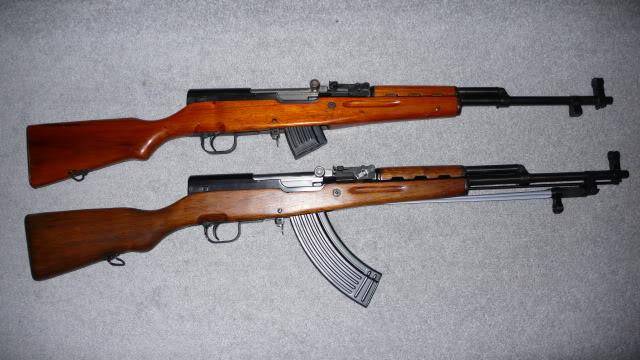
2 version of SKS-D.
c. Blackpowder
d. in .223 cal.
e. Sheet metal receiver. Fabricated in factory [0138], [0139],
f. Short barrel- Para, Sporter Carbine, Cowboy'due south Companion.
g. Thumbhole Carbine
h. SKS Hunter
i. SKS Sporter
j. SKS Sharpshooter
-----------------------------------------------------------------------
14. CHINESE SKS.Military vs. Commercial vs. Norinco.
a. Armed forces. All 3 production classes (early, mid & belatedly) were used past the armed forces. Quality tin range from excellent to good.
b. Commercial. SKS produced for commercial use but. It could be a standard SKS assembled from spare parts or a standard converted to a variant. Workmanship on these commercially built SKS varies. You'll accept to inspect them in person to know which ones are good and which ones are less than desireable. Quality is a mixed handbag.
c. Norinco. China North Industries Corporation is a conglomerate that was formed in 1980 to provide R&D, manufacturing, marketing and other services . It's involved in high-tech anti-shipping, battle tanks to oil field equipment.
When it comes to SKS, Norinco is basically an exporter. They exercise not actually manufacture them, they contract them out to factories that jointly develop other firearms with them.
Norinco isn't the sole exporter of the SKS out of Mainland china. Polytech is the other exporter.
--------------------------------------------------------------------------
xv. IMPORT STAMP.Dissimilar the U.s., nosotros in Canada are fortunate non to take an import stamp on our firearms. However that'south not to say we might non see it in the near time to come. There are talks about information technology every twelvemonth.
--------------------------------------------------------------
xvi. MY Research FROM. Site:
one. http://www.yooperj.com/SKS.htm
two. http://www.carbinesforcollectors.com/sks.htm
iii. http://web.archive.org/web/200712190...w.simonov.net/
4. http://www.sksboards.com/smf/index.php
5. http://forums.gunboards.com/
Books:
1. The SKS carbine (for collectors just) by Steve Keheda & Joe Poyer. 4th rev.
two. The SKS type 45 carbines by Duncan long
3. Simonov SKS45 type carbines past Wyant Lamont & Stephen Fuller.
----------------------------------------------------------------------
17. HOW TO.1. first place to visit is http://www.surplusrifle.com/sks/ for :
- Disassembly/reassembly
- Bolt disassembly/reassembly
- Cleaning
- Adjusting Sights
- Trigger job
- Videos
2. How to detach a SKS.
http://www.youtube.com/lookout man?v=_tVNb...eature=related
3. How to disassemble the commodities.
4. How to conform sights.
5. How to prevent slamfires.
Once in awhile a member would experience slam burn down with their new SKS, in most cases it is due to poor cleaning of the bolt. I recommend you completely dismantle the bolt, make clean thoroughly, use a q-tip in the firing pin tunnel. Firing pin should rattle freely later cleaning, use no oil. And when at the range, I recommend you load only 2 rounds in mag for the starting time ii shot.
When using commercial ammo because they have softer primer than the surplus ammo, you lot're more than likely to experience slamfire then I recommend installing a spring firing pivot, its available from sksman.com or you could purchase a 1949-part 1951 Russian SKS45 that comes with bound firing pin.
7. Trigger piece of work. please consult with a gunsmith earlier attempting any modification.
http://bsclem.8m.com/triggersafety.html
http://world wide web.yooperj.com/SKS-25.htm
http://votefordavid.blogspot.com/200...sks-burglarize.html
8. How to install ATI Strikeforce stock.
nine. How to open a Czech steel ammo box.
http://www.canadiangunnutz.com/forum...advertisement.php?t=95311
Source: https://www.milsurps.com/showthread.php?t=26665
0 Response to "How To Tell What Kind Of Sks You Have"
Post a Comment