

2x 5 6x 1 120
Canon RF 100-500mm F4.five-7.1 Fifty IS USM Lens Review

It was only a matter of time. A telephoto zoom lens with long focal lengths is a staple in many kits, and Canon'due south first such lens in the RF mountain was anxiously awaited. The RF lens serial is beingness filled with ultra-high performing models, and the Canon RF 100-500mm F4.5-7.ane L IS USM Lens, getting the professional person-course L-series designation, is another stellar performer, a must-have lens for many kits, including mine.
When introducing the Catechism EOS R with the RF mountain, Canon's first total-frame lens mount introduced since the EF (electronic focusing) mount was introduced over 30 years prior, Canon's engineers promised that all RF lenses would have advantages over their EF counterparts. Those advantages would include smaller size, lighter weight, and/or new features.
In this instance, indisputable is that we gain a very welcomed 100mm of focal length on the long cease, and lost is most fourteen% of the weight. While the size of this lens is very slightly increased, the smaller size of the R-series cameras offsets the difference, and the overall weight difference is substantially less.
Canon's engineers indicated that image quality, advantaged by new lens design opportunities made bachelor by the optimized RF mount, would exist minimally equivalent and oftentimes better. Canon's primeval RF mount lenses set up the epitome quality bar very high, and this lens is very heady in that regard.
The Canon RF 100-500mm F4.5-7.1 L IS USM Lens features a very long focal length range, ideal for wildlife and sports photography and perfect for families capturing memories while chasing their kids. With features like a Dual Nano USM AF system, close minimum focusing distance, five-stop image stabilization, weather condition sealing, and ready for the rigors of professional use build quality, this lens is very impressive in all regards.
You volition demand a camera with an RF-mount (the EOS R-series) to use this lens. Still, the RF 100-500 is good enough to justify buying an RF-mount camera just to enable its use, and the latest R-series cameras need piddling additional justification.

Focal Length Range
Choosing the correct focal length or focal length range is of utmost importance for lens selection. The focal length determines the perspective and framing combination. With a range that starts at 100mm (short telephoto) and goes to a super-telephoto 500mm (earlier adding extenders/teleconverters), this lens covers a broad range of uses, including many full general-purpose telephoto needs. In the past, I have had a 100-400mm lens with me a meaning pct of the time when out shooting. The RF 100-500 takes that lens'south place in my kit, providing an additional, significant 100mm on the long end.

One of the best uses for the 100-500mm focal length range is wild animals photography. At the wide end of the range, large or very close wildlife can exist independent in the frame, and environmental portraits can frequently exist created. From the other perspective, when the wild animals is scared of you (or vice versa) or you cannot or do not want to approach more than closely, 500mm permits capturing images of distant subjects rendered large in the frame. Smaller birds and animals, chipmunks for case, ofttimes need longer focal lengths to have a substantial size in the frame even at close distances, and these subjects are included on this telephoto zoom lens's uses list.

Staying with the fauna theme, the RF 100-500 is an ideal zoo and safari lens option.

A 100-500mm lens is very frequently a bang-up choice for photographing people. The broad cease has great portrait photography capabilities, even indoors, if acceptable ambient calorie-free is bachelor. The mid and long focal lengths, typically about-easily used outdoors, will provide a more-compressed appearance (due to the longer subject field altitude), and these focal lengths bring the potential for a strong background blur (long focal lengths magnify the background blur). Parents chasing kids can also find plenty of uses for this entire focal length range, including for their at-the-park and at-the-embankment needs. This focal length range is ideal for headshot portraits.
People participating in sports brand great subjects for this lens. While selecting a telephoto lens is a practiced choice from a safety perspective (prophylactic both from and for the subject), information technology is likewise a skilful option when there is a concrete or designated barrier to getting closer, such as a contend or the perimeter lines on a sports field. Sometimes, the action can exist close, and sports photography needs can range all of the focal lengths this lens avails. A total-frame photographic camera-mounted 500mm lens volition reach deep into big field events, roofing a very meaning portion of even large soccer, football, field hockey, lacrosse, etc. fields. At the aforementioned time, even shut activity will be nicely handled past the wide finish of this zoom lens. A zoom range (vs. using a prime or single focal length lens) means that the proper cropping of a field of study tin be established and maintained over a wide range of subject distances, resulting in full utilize of your camera'south imaging sensor, creating optimal image quality.

I utilise all of the focal lengths in this lens for landscape photography. I often discover information technology easy to create attractive, compressed-perspective landscape images when using a telephoto lens. Note that long focal lengths can make even a mediocre sunrise or sunset look amazing. This lens is a great pick for smaller flora, such as the flowers in your garden.
Wildlife, sports, and mural photographers make upwardly a large percentage of the owners of this lens, only there are enough of other uses for this wide 5x focal length range. Photojournalists, especially those with restricted access to their subjects, may find this focal length range very useful. With the shut minimum focus distance, this lens will work excellently for product photography. This lens will be exceptionally well represented at air shows.
Sometimes, laziness (peradventure "relaxation" sounds ameliorate) is a good reason to employ the 100-500mm focal length range. Sit down in the condolement of your machine, avert the need to cantankerous a creek, stay dorsum from the surf, etc. A benefit of having the wider focal lengths available is that photos can be framed appropriately from in forepart of line-of-sight obstacles.
I've only touched on a pocket-sized per centum of the uses for this lens. If I am non using it as my primary lens, the RF 100-500mm lens will be handling much of the balance of my needs, including complementing a 600mm lens when photographing wildlife or a 24-70mm lens when photographing landscapes.
Here are examples of what this huge focal length range looks similar:

Every bit I write this review, Canon RF lenses are not compatible with whatsoever cameras having an APS-C-sized imaging sensor. Should this lens someday become compatible with an ASP-C model, the ane.6x FOVCF sensor format will see an bending of view similar to a full-frame-mounted 160-800mm lens. This shifted-narrower angle of view range would take this lens'southward uses deeper into the sports and wildlife pursuits, with bird photography and large-field sports beingness especially good choices for this focal length range. While this range would still be useful for portrait photography on an APS-C camera, tightly-framed portraits would be almost comfy with considerable infinite needed for total body portraiture.

Max Aperture
Every bit always, the lower the aperture number, the more low-cal the lens volition let to reach the sensor. Each "finish" in aperture opening reduction (examples: f/2.eight, f/4.0, f/v.6, f/8, f/11) reduces the corporeality of light reaching the sensor by a cistron of 2, a substantial amount. Allowing more than lite to reach the sensor permits freezing activity and handholding the photographic camera in lower light levels and can also permit the apply of lower, less noisy, ISO settings. In addition to allowing more than light to accomplish the sensor, increasing the discontinuity opening permits a shallower DOF (Depth of Field) that creates a stronger, better field of study-isolating background blur (at equivalent focal lengths).
Because the aperture is measured as a ratio of lens opening to focal length and considering this lens' maximum opening does not increment fairly with focal length increment to maintain the same ratio, this lens'southward max discontinuity is a variable one, ranging from f/4.five to f/vii.i as the focal length is increased. These are relatively narrow apertures at any specific focal length.
The advantages of a narrow aperture are primarily related to the lens elements being significantly smaller in size. The benefits include a smaller overall lens size, a lighter weight, and a lower cost. Those are factors that we all can appreciate, and they employ to this specific lens.
The variable max aperture design provides the same size, weight, and cost efficiencies while delivering the widest aperture possible at each focal length. A downside is that the widest bachelor max aperture, f/4.v, cannot be used over the entire focal length range. Your camera will automatically account for the change in machine exposure modes, but making use of the widest-bachelor aperture in manual exposure fashion is complicated somewhat.
For many, especially those already owning the impressive Canon EF 100-400mm f/iv.5-5.6L IS II USM Lens (or any other Canon telephoto zoom lens), the unusually narrow to-f/7.i spec on the Canon RF 100-500mm F4.5-7.1 L IS USM Lens gives us pause. In part, the Dual Pixel CMOS AF system in Catechism's R-series cameras autofocus lenses with narrow apertures very adequately, making very narrow openings quite usable. None of united states of america was disappointed by the to-500mm function of the spec, but we still wanted to know if the aperture opening size was beingness sacrificed at the 400mm aperture in order to keep this lens compact and calorie-free.
What is the Canon RF 100-500mm F4.5-7.1 L IS USM Lens'due south maximum discontinuity opening at 400mm?
Answer 1: When the camera is prepare to 1/3-stop increments, the maximum 400mm aperture reported to the camera is rounded to f/6.iii.
Answer 2: When the photographic camera is set up to one/2-finish increments, the maximum 400mm aperture reported to the photographic camera is rounded to f/5.6.
I know, yous are at present planning to modify your R-serial cameras to use 1/2-stop increments. Don't carp as the difference is how the actual opening size is rounded (the true aperture is likely between these 2 numbers), likely holds for simply a brusque range of focal lengths, and even if there was a 1/3-stop difference, the difference in noise made visible by an offsetting 1/three-stop ISO change will not matter to nigh. If the RF 100-500mm lens is an estimated f/6.0 at 400mm, the departure betwixt it and the EF 100-400's f/5.6 is especially slight. Adobe software says that 400mm is f/vi.ii and 500mm is 7.0.
Again, do not overlook the fact that 500mm is a substantially longer focal length than 400mm. Both lenses are uniform with extenders, and with the ane.4x mounted, the EF 100-400 L 2's focal length range reaches to 560mm, but with a resulting max discontinuity of f/8.
Here is a comparative expect at the max discontinuity stride-down by focal length for this class of lens with an additional cavalcade necessitated by this lens.
| Model | f/4.5 | f/5.0 | f/five.6 | f/vi.3 | f/7.one |
| Canon EF 100-400mm f/4.five-5.6L IS Two USM Lens | 100-134mm | 135-311mm | 312-400mm | ||
| Canon RF 100-500mm F4.5-seven.1 50 IS USM Lens | 100-150mm | 151-253mm | 254-362mm | 363-471mm | 472-500mm |
| Nikon 80-400mm f/4.5-5.6G AF-S VR Lens | 80-134mm | 135-249mm | 250-400mm | ||
| Sigma 100-400mm f/five-6.3 DG OS HSM C Lens | 100-111mm | 112-233mm | 234-400mm | ||
| Sigma 150-600mm f/5-6.3 DG OS HSM Sports | 150-184mm | 185-320mm | 321-600mm | ||
| Sigma 150-600mm f/5-six.3 DG Os HSM C Lens | 150-179mm | 180-387mm | 388-600mm | ||
| Sony Fe 100-400mm f/4.v-v.half-dozen GM OSS Lens | 100-115mm | 116-161mm | 162-400mm | ||
| Tamron 150-600mm f/5-half dozen.3 Di VC USD G2 Lens | 150-212mm | 213-427mm | 428-600mm |
While the RF 100-500 holds f/4.5 modestly deeper into the focal length range, the EF 100-400 50 II holds a modest advantage at the longer focal lengths. Nonetheless, the differences are minor, and the RF 100-500 has a relatively broad discontinuity in its class.
Overall, this lens is non the platonic choice for stopping low calorie-free activity. When the dominicus goes downward, activity sports photographers using this lens (or similar models) will exist reaching for very high (noisy) ISO settings to keep images vivid enough when using the fast shutter speeds needed to freeze their subjects' movement. This lens is non the best pick for indoor sports or for photographing anything else that moves in depression lite.
Need f/54? This lens has y'all covered.
With the relatively narrow apertures, this lens cannot create the shallowest depth of field among comparable focal length lens, but past virtue of its long focal lengths, it will create a very strong background blur.
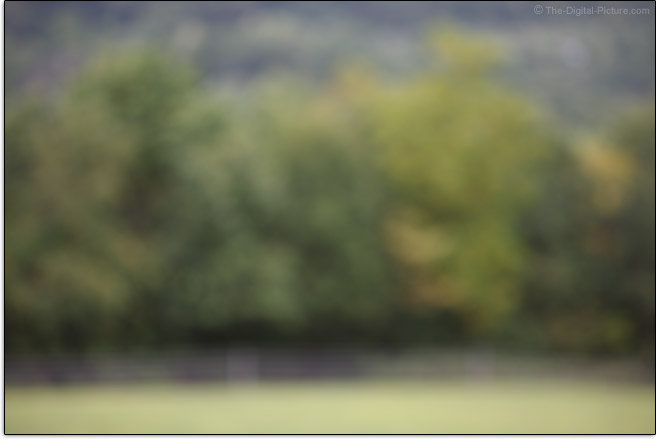
At 500mm, the background is a detail-less color blur.

Paradigm Stabilization
This lens begs to exist used handheld, and perhaps no lenses are improve versatility-improved by image stabilization than narrow aperture telephoto lenses. The Canon RF 100-500mm F4.v-7.1 L Lens'due south refined five-cease IS system greatly increases its usability and provides considerably improved image quality. When used on Canon R-series cameras featuring IBIS (In-Torso Image Stabilization), including the EOS R5 and EOS R6, coordinated image stabilization control takes this IS system's rating up to an fifty-fifty more than impressive 6 stops.
Put a camera with this lens mounted to your eye with IS turned off, and a very jittery prototype is what y'all should await to see. Movement the IS switch to the on position, and the deviation is dramatic, with the scene condign motionless.
While IS is keen for reducing camera shake-caused blur in images, information technology is too very helpful for precise framing of subjects in the viewfinder.
Aiding AF precision is another image stabilization benefit that should non be overlooked. The camera'southward AF organization can produce better focus precision if the image it sees is stabilized. Catechism contends that this is true even with a subject that is in motion and at activity-stopping shutter speeds.
It was not my steadiest twenty-four hours, just this lens set to 100mm (on the EOS R5) still turned out a high pct of sharp images at 1/4-2nd exposures, with nearly 0.three-second images being rendered sharply. At 500mm, a high per centum of 1/40-second exposures were abrupt, and most 1/30-second exposures were abrupt. Once more, I wasn't my steadiest on this solar day even so the camera and lens combination however turned in very good results.
Only a faint whirring tin can be heard from this IS system by an ear next to the lens in a repose environment. The IS sound is always nowadays, fifty-fifty when IS is switched off. Drifting of the scene is pocket-sized except when coming to a end after panning, or when used on a tripod. Handheld video recording is profoundly aided by this IS system.
As with many of Canon's Fifty-serial telephoto lenses, three IS modes are provided on the RF 100-500 — Mode i (general-purpose), Mode two IS (for panning with a subject area with 1 centrality of stabilization provided), and Manner 3. Style 3 is useful for tracking erratic activity. In Mode 3, paradigm stabilization is active and ready for utilise the moment the shutter releases. However, actual stabilization is non in upshot until that precise fourth dimension, and then acting equally Style 2 IS with panning motility detection in effect, providing Prototype Stabilization at right angles to the direction of the motility. The view seen through the viewfinder is not stabilized, allowing an erratic subject field to exist tracked without fighting against the image stabilization system trying to stabilize the view. Mode three (and off) permit like shooting fish in a barrel, precise framing when the lens is mounted on a tripod.
This image stabilization system is tripod-uniform, but Canon suggests that IS might non be fully effective when using a tripod. Depending on the scenario (stability of the mountain, shutter speed, etc.), switching IS off may be best.
Especially at 500mm, information technology is possible to move the lens outside of the image stabilization capabilities. The image stabilization arrangement is a huge aid to sharp handheld images, though it does non work miracles. Whether you lot demand to leave the tripod backside or just desire the speed and freedom afforded past handholding, the RF 100-500mm lens'southward paradigm stabilization is at that place for you.

Prototype Quality
Is the Canon RF 100-500mm F4.5-7.i L IS USM Lens sharp? My expectation was that we were going to be very happy with the functioning of this lens, performance at least as good as the phenomenal Canon EF 100-400mm f/4.five-five.6L IS II USM Lens that preceded information technology. My expectation was stiff enough that I preordered this lens, and my experience indicates that was a very good idea. My EF 100-400 L II was sold very rapidly afterward testing the new lens.
Succintly stated, the Catechism RF 100-500mm F4.5-vii.1 50 IS USM Lens creates extremely precipitous images from full-frame corner to full-frame corner, including at wide-open apertures, over the entire focal length range. This lens turns in outstanding performance.
Next, I'll share some less-formally-captured (not light amplification by stimulated emission of radiation-aligned, non lit by flash, precise focus distance per focal length not adhered to) exam results. I usually take this testing outdoors, but with night clouds and rain predominating, I was impatient and set up up a large test nautical chart indoors. The images beneath are 100% resolution center of the frame crops from images captured in RAW format using a Canon EOS R5. The images were processed in Canon's Digital Photograph Professional using the Standard Picture show Style with sharpness ready to "i" (0-10 calibration) and brightened by 0.v-stops. Note that images from almost cameras crave some level of sharpening merely too-loftier sharpness settings are destructive to epitome details and hide the deficiencies of a lens.

Except for slight camera movement showing betwixt some images, it is hard to know if the proper test images are loading. I'one thousand jumping ahead in regards to the extender discussion, only I wanted you lot to see how impressive this lens performs with the RF extenders. Yeah, there is an touch with the 2x, but these results readily amend with increased sharpness, the "South" designation.
In some lens designs, the plane of precipitous focus can movement forward or astern as a narrower aperture is selected. This consequence is called focus shift (balance spherical aberration or RSA), information technology is seldom (never?) desired, and this lens does not showroom such.
Next, we'll look at a comparison showing 100% farthermost-top-left-corner crops (1000mm results are extreme-top-right) captured and processed identically to the in a higher place centre-of-the-frame images. The lens was focused in the center of the frame to capture these images, meaning any curvature of the plane of precipitous focus would exist revealed.

Samples taken from the outer extreme of the paradigm circumvolve, full-frame corners in this case, tin exist counted on to show the worst functioning a lens is capable of. Yet, these results are really nice.
Corner sharpness does not always matter, simply for some disciplines, including landscape photography and environmental wildlife portraiture, two uses this lens is ideally suited for, it matters a lot. This lens has the sharp corners requirement covered.
The event of different colors of the spectrum being magnified differently is referred to as lateral (or transverse) CA (Chromatic Aberration). Lateral CA shows as color fringing forth lines of strong dissimilarity running tangential (meridional, correct angles to radii) with the mid and especially the periphery of the image circle showing the about pregnant amount every bit this is where the most significant deviation in the magnification of wavelengths typically exists.
With the right lens profile and software, lateral CA is oft easily correctable (frequently in the camera) past radially shifting the colors to coincide. However, information technology is always ameliorate not to accept the trouble in the first identify. Any color misalignment present can easily be seen in the site'southward paradigm quality tool, but let's besides wait at a set of worst-case examples. These are 100% crops from the extreme top left corner of ultra-high-resolution EOS R5 frames showing diagonal black and white lines.

There should simply be black and white colors in these images, with the additional colors showing the presence of lateral CA. For a zoom lens, the amount of color separation shown hither is quite mild. There is pocket-size lateral CA at 100mm, but nearly of the balance of the focal length range is practically free from this event. The colour fringing reverses, becoming balmy once more at 500mm.
A relatively mutual lens aberration is axial (longitudinal, bokeh) CA, which causes non-congruent focal planes of the various wavelengths of light, or more simply, different colors of lite are focused to different depths. Spherical abnormality along with spherochromatism, or a modify in the amount of spherical aberration with respect to colour (looks quite similar to axial chromatic aberration but is hazier) are other mutual lens aberrations to detect. Axial CA remains at least somewhat persistent when stopping down with the colour misalignment effect increasing with defocusing. The spherical aberration color halo shows lilliputian size change as the lens is defocused, and stopping downwards i to two stops generally removes this aberration.
In the real world, lens defects do not be in isolation with spherical abnormality and spherochromatism by and large found, at least to some degree, along with axial CA. These combine to create a less sharp, hazy-appearing image quality at the widest apertures.
In the examples beneath, look at the fringing colors in the out of focus specular highlights. Any fringing colour differences in the highlights created from the neutrally-colored subjects were introduced by the lens.

While I see some mild fringing color differences at the wide cease, this lens performs very well overall in this regard.
Flare and ghosting are caused past bright light reflecting off the surfaces of lens elements, resulting in reduced contrast and sometimes-interesting artifacts. Combating these problems is Canon's Air Sphere Coating (ASC), only with 20 elements in 14 groups (the EF Two has 21/16) and very long focal lengths, some flaring can still exist expected. Our standard flare testing uses the sunday in the corner of the frame, and about telephoto zoom lenses show very noticeable flaring in this test, especially at narrow apertures. Surprisingly, this lens, though non flare-gratis, shows relatively few flare furnishings. Things become wonky at 500mm, but having the lord's day in the frame at 500mm is not a skillful idea in the first place.
Flare effects can be embraced or avoided, or removal can be attempted. Removal is sometimes very challenging, and in some cases, flare effects tin can be quite subversive to paradigm quality.
Two lens aberrations that are particularly evident when shooting images of stars, mainly because vivid points of lite against a dark groundwork make them easier to encounter. Coma occurs when light rays from a signal of light spread out from that point, instead of being refocused as a point on the sensor. Coma is absent in the center of the frame, gets worse toward the edges/corners, and generally appears as a comet-like or triangular tail of lite which can exist oriented either away from the center of the frame (external coma), or toward the middle of the frame (internal coma). Coma clears as the discontinuity is narrowed. Astigmatism is seen as points of low-cal spreading into a line, either sagittal (radiating from the eye of the paradigm) or meridional (tangential, perpendicular to sagittal). Remember that lateral CA is another aberration apparent in the corners.
The images below are 100% crops taken from the top-left corner of EOS R5 frames.

Photographing stars with a telephoto lens and no tracking mount is challenging (hint: put the due north star in the center of the frame to avert star trails), simply these results are quite good.
Rare is a zoom lens completely free from geometric distortion over its entire focal length range. At 100mm, this lens has negligible distortion. Every bit the focal length is increased, pincushion distortion appears, getting stronger until virtually 400mm. The distortion amounts, at worst, are not bad.
Well-nigh modern lenses have lens correction profiles available, and distortion can easily be removed using these. Even so, distortion correction is subversive at the pixel level as some portion of the image must exist stretched, or the overall dimensions reduced.
As seen earlier in the review, the amount of blur a lens can produce is easy to show, and telephoto lenses are advantaged in this regard. Assessing the quality is more challenging due in part to the space number of variables present in all bachelor scenes. Here are some f/11 (for aperture blade interaction) examples.

The first gear up of 100% ingather examples show defocused highlights being rendered in very nice quality. The circles are nicely rounded and very evenly filled. The full reduced images in the second ready of examples also wait nifty.
Except for a minor number of specialty lenses, the broad aperture bokeh in the corner of the frame does non produce round defocused highlights with these furnishings taking on a cat's eye shape due to a class of mechanical vignetting. If y'all look through a tube at an angle, similar to the light reaching the corner of the frame, the shape is not round. That is the shape seen here.

Every bit the aperture narrows, the archway educatee size is reduced, and the mechanical vignetting absolves with the shapes becoming rounder.
When the discontinuity is stopped down, signal lite sources will show a sunstar effect of some grade. Each blade is responsible, via diffraction, for creating two points of the star outcome. If the blades are arranged opposite of each other (an even blade count), the points on the stars volition equal the bract count as two blades share in creating a unmarried pair of points. The blades of an odd bract count discontinuity are non opposing and the consequence is that each blade creates its own ii points. This lens's ix-blade count times two points means 18-point star effects.

The examples higher up were captured at f/16. In full general, the more than a lens is stopped down, the larger and better shaped the sunstars tend to exist, and nosotros meet that in these examples — the more than-stopped-down 100mm results accept nice star shapes, while the less-stopped-downwardly 500mm stars are not every bit dramatic. A narrow aperture lens does not afford much stopping downwardly prior to reaching apertures where diffraction causes noticeable softening of an image and typically does not produce the biggest or all-time-shaped sunstars.
"The RF100-500mm F4.five-vii.1 Fifty IS USM lens features an optical blueprint built specifically for the RF mount. This includes one Super UD lens, plus half-dozen UD elements to reduce both axial chromatic abnormality and chromatic aberration of magnification to achieve high paradigm quality throughout the zoom range." [Canon]
Overall, the Canon RF 100-500mm F4.five-seven.i L IS USM Lens produces outstanding image quality.

Focusing
Unless in transmission focus style, a lens's autofocus performance is an extremely important factor in realizing the image quality capability of a lens. To that signal, the Canon RF 100-500mm F4.five-vii.i L IS USM Lens, like the Canon RF lxx-200mm F2.8 L IS USM Lens, gets an advanced, loftier-performing AF system driven by Dual Nano USM (Ultrasonic) focus motors.
While Canon has been designing Nano USM AF systems into the latest Fifty-series RF lenses, this dual-motor pattern is being featured for simply the second time in the RF 100-500. What Catechism said about the RF 70-200 Dual Nano AF system over again applies: "The lens too incorporates a floating focus control ... that drives the 2 lens groups individually while using the ii aforementioned Nano USM motors. The floating focus lens element shortens focusing distance, providing users with fast, consequent and reliable performance."
Nano USM acts similar an ultra-fast version of STM AF, combining the benefits of a high-speed Ring USM actuator with an STM system stepping motor's tranquillity and shine, direct, lead screw-type drive system. Like Ring USM driven AF systems, Nano USM focuses extremely fast — about instantly. Like STM AF systems, Nano USM focuses almost silently and very smoothly. Cameras featuring Dual Pixel CMOS AF and Movie Servo AF make video recording very easy, and Nano USM lenses are very well-suited for this task. The shine focusing makes focus altitude transitions like shooting fish in a barrel on the viewer'southward eyes, and the sound of the lens focusing should not be picked up by the camera's mic. This lens's aperture changes are silent and smooth.

Catechism The statesA.'south Rudy Winston states: "Canon'southward new Nano USM applied science uses a completely different class gene, but achieves focus results within the lens via the same principles of ultrasonic vibration energy, transmitted here into linear (rather than rotational) movement inside the lens. This tiny new Ultrasonic motor achieves the combination of fast, nearly-instant response during even so image shooting, with the smoothness required for good focus during video recording." The RF 70-200 Dual Nano USM organization is pictured higher up.
Ring USM was Canon's quondam preference for high-finish lens AF systems. While most Ring USM lenses are cracking performers, they more often than not do not focus so smoothly in Movie Servo AF, and Ring USM EF lenses produce considerably more focus chatter. Nano USM lenses autofocus substantially smoother and quieter than Ring USM lenses.
Of utmost importance is AF accurateness, and from that perspective, all of the Nano USM-driven AF systems to date, including this 1, have performed impressively.
The RF 100-500 provides a focus limiter switch, permitting the autofocus range to be express to nine.viii' (3m) - ∞. If subjects are known to be within the narrower range, focus lock times may be decreased by using this switch.

Similar the RF 70-200mm f/ii.viii and the EF 100-400 L 2, the RF 100-500's mid-sized, ribbed-rubber-coated manual focus band is positioned behind the zoom ring. I ofttimes complain near rear-positioned focus rings being well-nigh the lens balance betoken, making them too easy to inadvertently turn with the left hand while operating the zoom band and while irresolute composition (including leveling the photographic camera). I'one thousand yet not fond of this design choice, but this focus ring is back far enough that, especially when the lens human foot is in hand, I'thousand not inadvertently turning it. That said, all lenses in this class share this trait. Position your left paw slightly forward of the manual focus ring or disable electronic manual focusing later on Ane-Shot AF in the photographic camera's menu to avoid any such problems.
Like STM, Nano USM utilizes a focus-by-wire or electric manual focus design (vs. a straight gear-driven system) with the manual focus ring electronically controlling the focus of the lens. FTM (Full Time Transmission) focusing is supported in AF style with the camera in 1-Shot Drive Mode, but the shutter release must be half-pressed for the focus band to become active. Note that FTM requires electronic manual focusing after I-Shot AF to be enabled in the camera'south AF carte du jour. The lens's switch must be in the "MF" position and the photographic camera meter must be on/awake for conventional transmission focusing to be available.
With electronics driving AF, the rate of focus alter caused by the focus ring can be electronically controlled, and it can be variable, based on the ring's rotation speed. I prefer a linear adjustment speed, and accept my cameras configured for such. That said, a least on the EOS R5, a variable manual focus charge per unit is non available. The RF 100-500mm L Lens transmission focus is adjusted at a nice rate, with approximately 120° of ring rotation from MFD to infinity.
The transmission focus ring has light resistance, and adjustments are shine and solidly centered with no unusual framing shift occurring. Precise manual focusing capabilities are provided.
Normal is for the composition to alter size in the frame (sometimes significantly) every bit focus is pulled from one extent to the other. This is referred to as focus breathing, a change in focal length resulting from a change in focus distance. Focus breathing negatively impacts photographers intending to use focus stacking techniques, videographers pulling focus, and anyone very-critically framing while adjusting focus. This lens shows a moderate corporeality of focus breathing.

While it can be an individual lens-specific attribute, the review lens does non showroom parfocal-like behavior. Though information technology attempts to adjust the focus altitude to be advisable for the selected focal length, focusing at the long end and zooming to the wide end does non event in precise focus. If you adjust the focal length, re-establish focus as suggested by these 100% crops focused at 500mm.

The 500mm result, sharpened in DPP to only "1", is another await at the sharpness being delivered by the R5 and RF 100-500mm philharmonic. Yep, the Canon EOS R5 eye AF can discover the eyes of homo-fabricated animals, including frog pool floats.
A focus distance window is not provided, but a focus altitude meter shows in the lower portion of the camera'south electronic viewfinder during manual focusing.
With a minimum focus distance of 35.4" (900mm), shorter than that of the already peachy EF 100-400 Fifty 2 capability, this lens has a very attractive 0.33x maximum magnification spec at 500mm.
| Model | MFD | MM | |
| Canon EF 100-400mm f/four.5-5.6L IS Ii USM Lens | 38.four" | (980mm) | 0.31x |
| Canon RF 100-500mm F4.5-7.i L IS USM Lens | 35.4" | (900mm) | 0.33x |
| Nikon lxxx-400mm f/four.5-5.6G AF-S VR Lens | 68.9" | (1750mm) | 0.20x |
| Sigma 100-400mm f/5-6.3 DG Os HSM C Lens | 63.0" | (1600mm) | 0.26x |
| Sigma 150-600mm f/5-6.3 DG Bone Sports Lens | 102.4" | (2600mm) | 0.20x |
| Sigma 150-600mm f/v-half dozen.3 DG Os C Lens | 110.2" | (2800mm) | 0.20x |
| Sony Iron 100-400mm f/4.v-5.six GM OSS Lens | 38.half dozen" | (980mm) | 0.35x |
| Sony FE 200-600mm f/5.6-six.3 G OSS Lens | 94.5" | (2400mm) | 0.20x |
| Tamron 150-600mm f/5-6.iii Di VC G2 Lens | 86.6" | (2200mm) | 0.26x |
As often the case, this lens focuses closer at the widest focal length. Hither are some specific examples:
At 100mm: 2.95' (0.9m) — 0.12x maximum magnification
At 300mm: iii.28' (one.0m)
At 500mm: 3.94' (1.2m) — 0.33x maximum magnification
At 100mm, a subject measuring approximately ix.5 ten 6.3" (241 x 161mm) fills the frame of a full-frame camera at the minimum focus distance. At 500mm, a subject measuring approximately 4.2 x 2.eight" (117 x 78mm) does the same.

This lens is a neat choice for photographing butterflies and flowers.
Need a shorter minimum focus altitude and college magnification? An extension tube mounted behind this lens should provide a modest decrease and increase, respectively. Extension tubes are hollow lens barrels that shift a lens farther from the camera, allowing shorter focusing distances at the expense of long-distance focusing. Electronic connections in extension tubes allow the lens and camera to communicate and otherwise office as normal. As of review time, Canon does not offer RF mount-compatible extension tubes, but 3rd-political party options are available.

Extenders / Teleconverters
An even better option for increasing the magnification of this lens is to use extenders, also referred to as teleconverters. The Canon RF 100-500mm F4.five-7.1 L IS USM Lens is compatible with the simultaneously announced Canon RF one.4x Extender and Canon RF 2x Extender — with a catch.

These extenders, like near other loftier-performing options, have a front extension that requires room behind the mounted lens'southward rear chemical element. With some EF lenses, nosotros found that Canon EF extenders were compatible with lenses Canon did non signal being compatible (such as the Catechism EF 70-300mm f/4-v.6L IS USM Lens) under a status. If the lens was zoomed to a specific minimum focal length, the rear element moved forrard enough to clear the extender. That is the instance with the RF 100-500, and 300mm is that minimum compatible focal length.
The RF 100-500 physically prevents an extender from existence mounted behind information technology at focal lengths below 300mm, and physically prevents the lens from being zoomed to focal lengths wider than 300mm when an extender is attached. After detaching an extender, the lens may demand to be zoomed to a focal length longer than 300mm prior to zooming out to wider angles, especially if any force per unit area was being applied to the front, such as occurs when sitting upright on a desk. This feature prevents the lens from collapsing when the extender is removed.
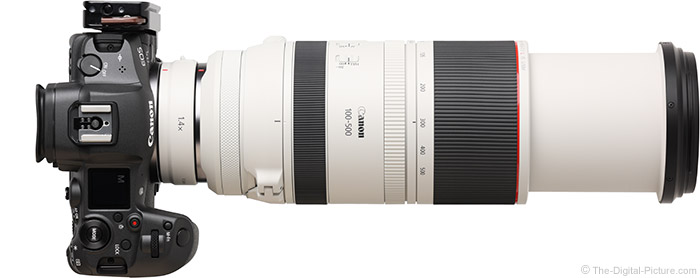
Mounting the Canon RF ane.4x Extender behind the RF 100-500 creates a 420-700mm f/8-10 image stabilized lens. Those focal lengths volition exist attractive to wildlife and sports photographers, but the max aperture range will not be as welcomed.
In that location is always some epitome quality reduction with an extender mounted, merely the 1.4x caused degradation is quite pocket-size, as information technology is with the EF 100-400 L Ii. Lateral CA is increased slightly, impacting corner sharpness modestly. AF speed is very mildly impacted with this extender in use, with performance remaining excellent in fifty-fifty rainy outdoor conditions.
Mounting the Catechism RF 2x Extender backside the RF 100-500 creates a 600-1000mm f/11-14 paradigm stabilized lens (that goes to f/91). Those focal lengths will be especially attractive to bird photographers, and the max aperture range volition over again not be as welcomed, sending ISO settings noisy-high in many circumstances.
The image degradation caused by the addition of a 2x extender into a lens'southward optical pattern is usually stiff, with contrast and resolution taking hits. That said, equally seen earlier in the review, this lens performs reasonably well with the 2x mounted, exceeding my expectations. Especially with a bit of extra sharpening applied, 1000mm results from this lens are quite usable. Lateral CA is increased a noticeable amount past the RF 2x.
Extenders always impact AF speed, but functioning remains good in even rainy outdoor weather. Look some focus hunting in very low low-cal scenarios. But beingness able to autofocus an f/14 max aperture lens is a superpower of some of Canon'southward latest R-series cameras, including the R5 and R6.
Note that this lens cannot fully retract for storage while an extender is mounted.

Build Quality & Features
The Canon RF 100-500mm F4.v-vii.1 L IS USM Lens has construction similar to the other recently introduced white Canon 50-Series lenses, with membership indicated by the cerise band and the "L" in the moniker. Members of this best-available serial of professional-grade lens models are built tough, ready for the rigors of daily professional employ. Those familiar with Canon's RF 70-200mm F2.viii L lens and similar EF models volition not be disappointed with this one.
While Canon's RF L lenses have on a slightly updated await from the EF counterparts, those familiar with EF L lenses will immediately recognize this lens' heritage. Expect the RF 100-500 lens to have splendid fit and finish, similar to the RF 70-200 f/2.8.

The Canon RF 100-500mm F4.5-7.1 L IS USM Lens has an aesthetically pleasing design featuring a shine, rather broad exterior bore that is comfortable in hand. Much of the lens outside is constructed of high-quality engineering plastic.
The forward-positioned rubber-coated zoom band is substantial in size, measuring ii.47" (62.8mm). Information technology is polish in rotation and has no play, and the 120° amount of rotation is ideal for easy adjustment. Full extent zooming feels most natural with a finger reset on the zoom band midway through the rotation.
All Canon RF lenses feature a knurled Control Ring, able to be configured for fast access to settings including aperture, ISO, and exposure compensation. Positioning this ring behind the tripod band makes it very piece of cake to observe while keeping information technology out of the mode of the other two rings. Note that the control ring is clicked by default, and this ring's clicks are going to be audible in photographic camera-based audio recordings. Catechism offers a control band click stop removal service (at a price).
The RF 100-500 L lens gets the oestrus shield coating, including the white color, of the RF seventy-200. While a white lens might be less stealthy, garnering more attention than a black lens, white remains significantly cooler under a bright sun, reducing the temperature change and any negative problems that such contributes to, including function expansion, for consistent performance in high temperatures. I'll let you decide if white appears more professional, but white does hide dirt and dust better than black.

The RF 100-500 gets a total complement of switches. All of the switches are very shallow, with the IS-related switches beingness tactilely delineated by a slightly raised area of the lens. Based on the RF 70-200 design, these switches have sufficient raised surface area in the center to brand them easily usable, fifty-fifty with gloves on. Note that the RF 100-400'south switches are in front of the tripod ring vs. nearly the mount on the EF 100-400 50 2, making room for the control ring.
Like about lenses in its course, the RF 100-500 features an extending pattern, and like the EF 100-400 Fifty IS Ii, the RF 100-500 utilizes a rotational type zoom ring (vs. a button-pull blueprint). Prefer push button and pull? Grasp the front of the lens at the base of the hood and practice that. The 500mm end becomes a bit tight, only the method works well at most focal lengths.
Besides like the EF 100-400 L IS II, the RF 100-500 features a torque adjustment ring, dubbed the Zoom Touch Adjustment Ring (ZTAR) in the predecessor. Positioned between the zoom ring and switch panel, the torque adjustment ring allows the zoom friction to exist set as desired, though not completely locked. While many lenses provide a zoom lock switch that is usable only with the lens in its most-retracted position, the torque adjustment ring offers far more flexibility. Rotate the ring a short amount to adjust the focus ring resistance between smooth and tight, the latter permitting whatsoever focal length settings to be firmly held, greatly enhancing a potent upward or downward angle shooting experience. Slightly unusual is that my band has a bit of flex to it when in the tight position.

This lens is weather-sealed and built for outdoor professional use in conditions that are not always favorable. Sometimes unfavorable atmospheric condition happen indoors, including on my desk. Immediately upon inflow, I captured product images of the RF 100-500 and then prepare information technology on the desk beside me, balanced on the lens foot with an EOS R5 mounted. Not long after doing and then, I bumped the camera with my elbow. The lens tipped on its side, knocking over a large cup of water, which dumped onto the top of the lens. While I don't regularly test expensive weather-sealed lenses past pouring water on them, this was a perfect examination. I didn't panic because I knew the lens was built to easily withstand such incidents, and no harm was washed.
Lenses that extend movement air in and out during use. To avert dust and moisture entry, this lens design includes a ventilation route that permits airflow while filtering grit and moisture.

The front and rear elements are fluorine-coated, helping dust and h2o drops to shed off (or easily blow off) of the front and rear lens elements. Cleaning more than problematic issues, such as fingerprints, is much easier to accomplish with this coating, and the departure is especially appreciated in the field.
The RF 100-500 gains 100mm of focal length range over the EF 100-400 L II while losing 14% of its weight. Disappointed nearly that is no one. Weighing in at 48.one oz (i,365g), the RF 100-500 is non a light lens. However, this lens is calorie-free for its course.
| Model | Weight | Dimensions w/o Hood | Filter | Year | ||
| Canon EF 100-400mm f/4.5-v.6L IS Ii USM Lens | 55.iv oz | (1570g) | 3.seven x seven.6" | (94.0 10 193.0mm) | 77mm | 2014 |
| Catechism RF 100-500mm F4.5-7.1 Fifty IS USM Lens | 48.1 oz | (1365g) | 3.7 x 7.6" | (93.viii ten 207.6mm) | 77mm | 2020 |
| Nikon 80-400mm f/4.5-5.6G AF-Southward VR Lens | 55.4 oz | (1570g) | iii.8 x eight.0" | (95.v x 203.0mm) | 77mm | 2013 |
| Sigma 100-400mm f/5-6.3 DG OS HSM C Lens | 40.9 oz | (1160g) | 3.4 10 7.ii" | (86.4 x 182.3mm) | 67mm | 2017 |
| Sigma 150-600mm f/v-6.3 DG Bone HSM C Lens | 68.i oz | (1930g) | iv.1 x 10.2" | (105.0 10 260.1mm) | 95mm | 2015 |
| Sigma 150-600mm f/5-6.3 DG OS Sports Lens | 101.0 oz | (2860g) | 4.eight 10 11.4" | (121.nine x 289.6mm) | 105mm | 2014 |
| Sony Iron 100-400mm f/4.5-5.6 GM OSS Lens | 49.two oz | (1395g) | three.seven x 8.ane" | (93.nine ten 205.0mm) | 77mm | 2017 |
| Sony Atomic number 26 200-600mm f/5.half dozen-vi.3 Grand OSS Lens | 74.8 oz | (2120g) | iv.v x 12.5" | (115.5 x 318.0mm) | 95mm | 2019 |
| Tamron 150-600mm f/5-half dozen.iii Di VC G2 Lens | 71.0 oz | (2010g) | 4.3 x ten.2" | (108.iv x 260.2mm) | 95mm | 2016 |
| Tamron 150-600mm f/five-six.3 Di VC Lens | 68.8 oz | (1950g) | 4.ii x 10.1" | (105.half-dozen x 257.8mm) | 95mm | 2013 |
For many more comparisons, review the complete Canon RF 100-500mm F4.5-7.i L IS USM Lens Specifications using the site's lens specifications tool.
Here is a visual comparison:

Positioned above from left to correct are the following lenses:
Catechism EF 100-400mm f/4.v-5.6L IS II USM Lens
Catechism RF 100-500mm F4.5-7.ane L IS USM Lens
Sigma 150-600mm f/five-half dozen.3 DG Os HSM C Lens
Sony FE 200-600mm f/five.half dozen-6.iii G OSS Lens
The same lenses are shown below with their hoods in place.

Utilize the site's product image comparison tool and large lens product image comparison tool to visually compare the Catechism RF 100-500mm F4.5-7.1 L IS USM Lens to other lenses. Note that the above visual comparisons are specially relevant for those comparing betwixt camera systems. Those committed to the R-serial need to also business relationship for the mount adapter size.
Tripod rings provide balanced tripod mounting of a camera and lens, avoiding tripod head and camera strain, avoiding sag later on lock-down, and assuasive easy camera rotation. Canon includes the Tripod Mount Ring F (WIII) with this lens.
Like the RF lxx-200 Mount Ring East blueprint, the RF 100-500's lightweight tripod mountain ring is somewhat alpine, leaving acceptable room for fingers over the pes, withal compact. This is a solid mount with very slight flex at the ring, and when the locking knob is tightened with relatively lite pressure, the ring locks very tightly. The RF 100-500'southward Mount Band is not riding on steel bearings, and the friction fit is not especially shine during rotation until the locking knob is quite loose. I initially didn't like the RF 70-200 band's smoothness only have acclimated to using a less-tight knob setting than seems right to obtain shine rotation (I have a tendency to over-tighten anything that screws downwards).
It is oft beneficial to have a tripod band locked in a precise 90° bending increment. While this ring does not have click stops to point these positions, the neckband has indicator lines that tin exist aligned with a tiny notch on the top of the lens barrel.

As indicated by the low-profile hinge on the meridian, the RF 100-500's tripod mountain ring is removable. Fully loosen the lock knob, and so pull information technology out to release the tripod collar completely, unhinging it while the lens is nevertheless mounted to the photographic camera. Dissimilar the EF 100-400 50 Ii'due south foot, the RF 100-500 50's human foot is not removable, and replacement lens anxiety volition require the entire ring to exist replaced. Consider a Wimberley P20 Lens Plate for use in Arca-standard quick-release clamps.
Weight specifications omit the tripod mountain band when such is removable, an attractive reason for manufacturers to make the band removable in the outset identify (and a reason to sometimes remove the ring). The Tripod Mount Ring F (WIII) adds approximately 5.6 oz (160g) to the in-apply weight.
The RF 100-500 lens uses ultra-common standard 77mm threaded filters. Filters of this size are somewhat big, but a huge number of lenses using 77mm filters makes effects filter options such as round polarizer and neutral density filters easy to share. Larger filters price more than small ones, merely sharing is cost-reducing, and fewer filters swallow less space in the haversack.
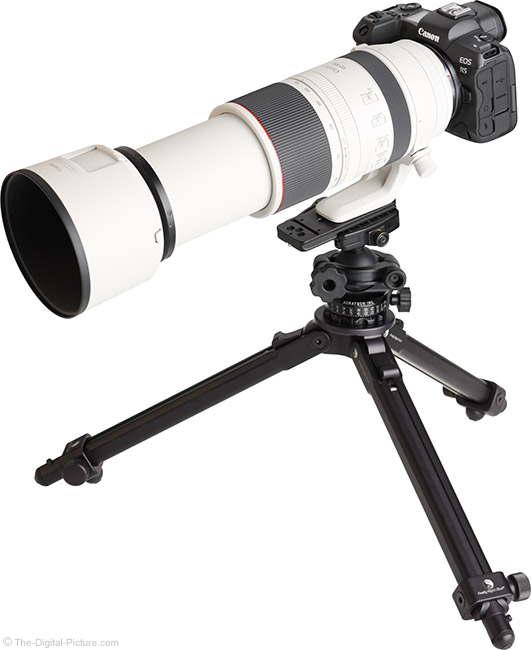
Standard is for the lens hood to be included in the box with Canon L-serial lenses. The RF 100-500 comes with the white color matching ET-83F (WIII) lens hood, the aforementioned hood included with the RF 70-200, in the box. The slightly flexible (helpful for absorbing impact), molded plastic ET-83F hood has a matte finish with a mold-ribbed interior and a fashionable black stop on the front (this is not a rubberized surface). The round shape nicely facilitates employ equally a camera stand when conditions allow. The ET-83F (WIII) is a relatively large hood that adds meaning protection to the front end lens element – protection from vivid flare-causing lights, protection from scratch-causing impacts, and protection from grit and rain. The button-button release makes installation and removal smooth and piece of cake.
In one case again, a door is provided on the side of this lens hood for filter rotation access. I find the door often getting opened inadvertently, specially from the camera being inserted into or removed from a example. I just accept slim round polarizer filters, and I'k not able to rotate them at all through the opening. Even if my filters were rotatable, the corporeality of rotation possible through the minor opening is minimal with many total-width swipes required for the most common rotation amount, the 90° rotation often required when switching the camera from horizontal to vertical orientation. I epoxied the hood window closed on my EF 100-400 L 2 hood, and plan to practise the same with this ane.
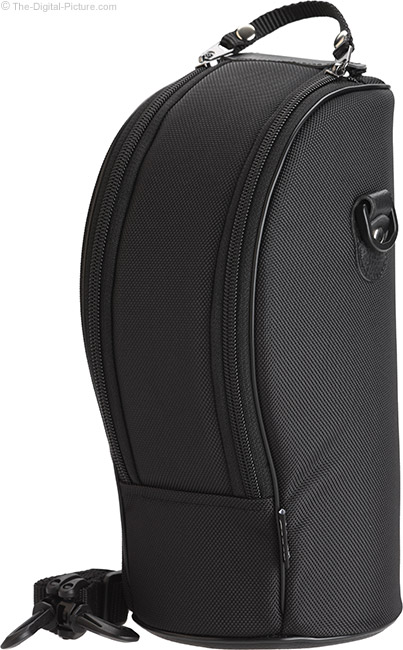
Standard is for Canon to include a lens case with all L-series lenses, and this one gets the new Canon LZ1328 Lens Instance. From the image, you probable figured out that the new office is the color black. This example is well-constructed, quite protective, and with a double-zippered opening, piece of cake to utilize.
As y'all likely recognized, the LZ1328 holds only the lens. In the field, information technology is ordinarily beneficial to take a photographic camera mounted for fast use. With the Canon EOS R5 or EOS R6 mounted, the overall camera and lens length, including the lens cap, is 11.2" (285mm). That means the excellent Think Tank Photo Digital Holster 30 V2.0 is only correct for a convenient and meaty, notwithstanding protective, carrying solution. Note that a lens plate may inhibit fit into this case.

Price, Value, Wrap Up
This lens is rather expensive, and the cost will represent a hurdle for non-serious photographers. However, this highly-useful lens performs up to its cost. As a most-used lens, the value is in that location.
Canon "RF" lenses are compatible with all Canon EOS R-series cameras. Canon USA provides a 1-year limited warranty.
The reviewed Canon RF 100-500mm F4.5-seven.1 L IS USM Lens was purchased online-retail.
Alternatives to the Canon RF 100-500mm F4.5-7.1 L IS USM Lens
The primary alternative telephoto zoom lens to consider is the fantabulous Canon EF 100-400mm f/4.5-five.6L IS II USM Lens. Check out the In-Depth: Canon RF 100-500mm F4.5-seven.1 L IS USM Lens Compared to EF 100-400mm f/iv.5-5.6L IS II USM Lens article for the full details. My advice is to become the RF lens.

Summary
Many referred to 2014 as the "Year of the Lens", and the Canon EF 100-400mm f/four.5-v.6L IS Two USM Lens was one of many 2014-announced models. That lens was the hottest, nearly in-demand model of them all. The Catechism EF 100-400mm f/4.5-5.6L IS II is in an aristocracy class of zoom lenses capable of producing prime-form paradigm quality at all available aperture and focal length settings. Put a very useful focal length range into a ruggedly-built, pro-form lens with fast and accurate AF, very constructive image stabilization, and very impressive image quality, and it is destined to be a very popular model. The 100-400 Fifty II quickly became one of my favorite and virtually-used lenses.
The EF 100-400mm Fifty II USM Lens gear up the bar very high, but the Canon RF 100-500mm F4.five-7.1 L IS USM Lens has cleared information technology. Only six years after the EF 100-400 L 2 was released, the Canon RF 100-500mm F4.v-7.1 Fifty IS USM Lens is on the streets. Featuring a lighter weight and longer focal length range, this lens surpasses the impressive predecessor in many regards and gained firsthand stiff popularity. This lens is an integral part of my kit. It and I have been spending a lot of time together.
Bringing you lot this site is my full-fourth dimension job (typically sixty-80 hours per calendar week). Thus, I depend solely on the commissions received from you using the links on this site to make any purchase. I am grateful for your support! - Bryan
My Recommended Canon RF 100-500mm F4.v-7.one L IS USM Lens Retailers
Hire the Catechism RF 100-500mm F4.v-7.1 50 IS USM Lens
The Tip Jar
More Catechism RF 100-500mm F4.5-seven.one Fifty IS USM Lens Related Information
Bryan Recommends Buying Information technology Here

2x 5 6x 1 120,
Source: https://www.the-digital-picture.com/Reviews/Canon-RF-100-500mm-F4.5-7.1-L-IS-USM-Lens.aspx
Posted by: gonzalesmiled1958.blogspot.com
0 Response to "2x 5 6x 1 120"
Post a Comment