

5 11 In Decimal Form
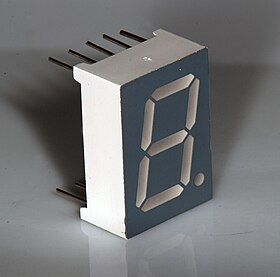
A typical 7-segment LED brandish component, with decimal point in a wide DIP-10 package
A vii-segment display is a form of electronic display device for displaying decimal numerals that is an alternative to the more complex dot matrix displays.
7-segment displays are widely used in digital clocks, electronic meters, basic calculators, and other electronic devices that display numerical data.[ane]
History
Seven-segment representation of figures tin can exist plant in patents as early equally 1903 (in U.Due south. Patent 1,126,641), when Carl Kinsley invented a method of telegraphically transmitting letters and numbers and having them printed on record in a segmented format. In 1908, F. W. Wood invented an 8-segment display, which displayed the number 4 using a diagonal bar (U.South. Patent 974,943). In 1910, a 7-segment brandish illuminated past incandescent bulbs was used on a power-institute banality room signal panel.[2] They were as well used to prove the dialed telephone number to operators during the transition from manual to automatic telephone dialing.[3] They did not accomplish widespread utilize until the advent of LEDs in the 1970s.

Filament seven-segment display
Some early seven-segment displays used incandescent filaments in an evacuated bulb; they are also known as numitrons.[4] A variation (minitrons) made utilize of an evacuated potted box. Minitrons are filament segment displays that are housed in DIP packages similar modern LED segment displays. They may have up to 16 segments.[5] [6] [7] At that place were also segment displays that used small incandescent light bulbs instead of LEDs or incandescent filaments. These worked similarly to modern LED segment displays.[8]
Vacuum fluorescent display versions were also used in the 1970s.[ix]
Many early (c. 1970s) LED seven-segment displays had each digit congenital on a unmarried die. This made the digits very modest. Some included magnifying lenses onto the blueprint in an attempt to brand the digits more legible.[ten] [11]
The seven-segment design is sometimes used in posters or tags, where the user either applies color to pre-printed segments, or applies color through a seven-segment digit template, to etch figures such as product prices or telephone numbers.
For many applications, dot-matrix LCDs have largely superseded LED displays in general, though even in LCDs, seven-segment displays are common. Unlike LEDs, the shapes of elements in an LCD console are arbitrary since they are formed on the brandish by photolithography. In dissimilarity, the shapes of LED segments tend to be simple rectangles, reflecting the fact that they have to be physically moulded to shape, which makes it difficult to form more complex shapes than the segments of 7-segment displays. Withal, the high recognition cistron of seven-segment displays, and the comparatively high visual contrast obtained by such displays relative to dot-matrix digits, makes seven-segment multiple-digit LCD screens very mutual on basic calculators.
The seven-segment display has inspired type designers to produce typefaces reminiscent of that brandish (just more legible), such as New Alphabet, "DB LCD Temp", "ION B", etc.
Using a restricted range of letters that look similar (upside-downwards) digits, seven-segment displays are commonly used past schoolhouse children to form words and phrases using a technique known as "calculator spelling".
Implementations

A multiplexed 4-digit, seven-segment display with only 12 pins

A 4-digit display scanning by columns to brand the number 1.234
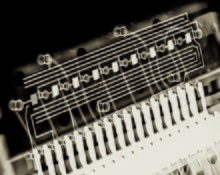
X-Ray of an viii-digit 7-segment multiplexed LED display from a 1970s estimator
Seven-segment displays may use a liquid crystal display (LCD), a light-emitting diode (LED) for each segment, an electrochromic display, or other lite-generating or controlling techniques such every bit cold cathode gas belch (Panaplex), vacuum fluorescent (VFD), incandescent filaments (Numitron), and others. For gasoline price totems and other large signs, vane displays made up of electromagnetically flipped light-reflecting segments (or "vanes") are nevertheless commonly used. A precursor to the vii-segment display in the 1950s through the 1970s was the cold-cathode, neon-lamp-like nixie tube. Starting in 1970, RCA sold a brandish device known as the Numitron that used incandescent filaments arranged into a seven-segment display.[12] In USSR, the first electronic calculator "Vega", which was produced from 1964, contains 20 decimal digits with seven-segment electroluminescent display.[13]
In a simple LED package, typically all of the cathodes (negative terminals) or all of the anodes (positive terminals) of the segment LEDs are connected and brought out to a common pin; this is referred to every bit a "mutual cathode" or "common anode" device.[xiv] Hence a vii segment plus decimal betoken package will but crave nine pins, though commercial products typically contain more pins, and/or spaces where pins would go, in society to match standard IC sockets. Integrated displays likewise be, with single or multiple digits. Some of these integrated displays incorporate their own internal decoder, though most do not: each private LED is brought out to a connecting pin equally described.
Multiple-digit LED displays equally used in pocket calculators and similar devices used multiplexed displays to reduce the number of I/O pins required to control the brandish. For instance, all the anodes of the A segments of each digit position would be continued together and to a driver circuit pin, while the cathodes of all segments for each digit would be connected. To operate any item segment of any digit, the decision-making integrated circuit would plough on the cathode driver for the selected digit, and the anode drivers for the desired segments; and so afterward a short blanking interval the adjacent digit would be selected and new segments lit, in a sequential fashion. In this fashion an eight digit display with seven segments and a decimal indicate would require only 8 cathode drivers and viii anode drivers, instead of sixty-iv drivers and IC pins.[fifteen] Often in pocket calculators the digit drive lines would exist used to scan the keyboard as well, providing farther savings; however, pressing multiple keys at once would produce odd results on the multiplexed brandish.
Although to a naked centre all digits of an LED display appear lit, only i digit is lit at any given time in a multiplexed display. The digit changes at a high enough rate that the homo eye cannot see the flashing (on earlier devices it could be visible to peripheral vision).
Characters
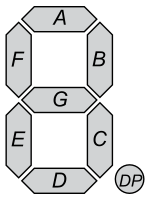
The individual segments of a seven-segment display
The 7 segments are arranged as a rectangle of two vertical segments on each side with one horizontal segment on the top, center, and bottom. Often the rectangle is oblique (slanted), which aids readability.[ citation needed ] In most applications, the segments are of well-nigh compatible shape and size (usually elongated hexagons, though trapezoids and rectangles can also exist used), though in the case of adding machines, the vertical segments are longer and more than oddly shaped at the ends in an try to further enhance readability. The seven elements of the display can be lit in unlike combinations to represent the Arabic numerals.
The segments are referred to past the letters A to Chiliad, where the optional decimal point (an "8th segment", referred to as DP) is used for the display of non-integer numbers.[16] [14] A single byte can encode the full state of a 7-segment-display including the decimal point. The nigh popular bit encodings are gfedcba and abcdefg. In the gfedcba representation, a byte value of 0x06 would turn on segments 'c' and 'b', which would brandish a '1'.
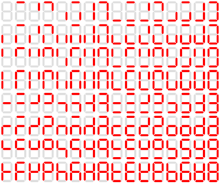
16×viii grid showing the 128 states of a seven-segment display[17]
Decimal
The numerical digits 0 to 9 are the nearly mutual characters displayed on seven-segment displays. The nigh common patterns used for each of these is:[18]
Alternating patterns: The numeral 1 may be represented with the left segments, the numerals 6 and nine may exist represented without a 'tail', and the numeral 7 represented with a 'tail':[19]
In Unicode 13.0, 10 codepoints had been given for segmented digits 0–ix in the Symbols for Legacy Computing block, to replicate early computer fonts that included seven-segment versions of the digits.[xx] The official reference shows the less-common iv-segment "7". The characters are faux as:
| 0 | 1 | 2 | iii | iv | five | 6 | 7 | viii | 9 | |
| U+1FBFx |  |  |  |  |  |  |  |  |  |  |
Hexadecimal
Four binary bits are needed to specify the numbers 0–9, but tin also specify 10–fifteen, so ordinarily decoders with 4 scrap inputs can also brandish Hexadecimal (Hex) digits. Today, a combination of majuscule and lowercase letters is commonly used for A–F;[21] this is done to obtain a unique, unambiguous shape for each hexadecimal digit (otherwise, a capital 'D' would wait identical to a '0' and a capital 'B' would look identical to an '8').[22] [23] [24] [25] Also the digit '6' must be displayed with the top bar lit to avoid ambiguity with the alphabetic character 'b'.
The following lookup table may be useful for writing code to drive a vii-segment brandish.
| Digit | Brandish | p | a | b | c | d | e | f | g | pabcdefg | hex pabcdefg | pgfedcba | hex pgfedcba |
|---|---|---|---|---|---|---|---|---|---|---|---|---|---|
| 0 | | on | on | on | on | on | on | 01111110 | 0x7E | 00111111 | 0x3F | ||
| 1 | | on | on | 00110000 | 0x30 | 00000110 | 0x06 | ||||||
| ii | | on | on | on | on | on | 01101101 | 0x6D | 01011011 | 0x5B | |||
| three | | on | on | on | on | on | 01111001 | 0x79 | 01001111 | 0x4F | |||
| 4 | | on | on | on | on | 00110011 | 0x33 | 01100110 | 0x66 | ||||
| 5 | | on | on | on | on | on | 01011011 | 0x5B | 01101101 | 0x6D | |||
| 6 | | on | on | on | on | on | on | 01011111 | 0x5F | 01111101 | 0x7D | ||
| 7 |  | on | on | on | 01110000 | 0x70 | 00000111 | 0x07 | |||||
| 8 | | on | on | on | on | on | on | on | 01111111 | 0x7F | 01111111 | 0x7F | |
| nine | | on | on | on | on | on | on | 01111011 | 0x7B | 01101111 | 0x6F | ||
| A |  | on | on | on | on | on | on | 01110111 | 0x77 | 01110111 | 0x77 | ||
| b |  | on | on | on | on | on | 00011111 | 0x1F | 01111100 | 0x7C | |||
| C |  | on | on | on | on | 01001110 | 0x4E | 00111001 | 0x39 | ||||
| d |  | on | on | on | on | on | 00111101 | 0x3D | 01011110 | 0x5E | |||
| Eastward |  | on | on | on | on | on | 01001111 | 0x4F | 01111001 | 0x79 | |||
| F |  | on | on | on | on | 01000111 | 0x47 | 01110001 | 0x71 |
Messages
Most messages of the Latin alphabet can be reasonably implemented using seven segments. Though not every alphabetic character is available, it is possible to create many useful words. Past choosing better synonyms, it is possible to work around many shortcomings of seven-segment alphabet encodings. Some capital letter letters ('I', 'O', 'South', 'Z') expect identical to numerical digits ('1', '0', '5', 'ii'), though it is possible to utilize lower-case 'o' and 'i', or putting 'I' on the left. Lowercase letters 'b' and 'q' are identical to the alternating numerical digits 'half dozen' and '9'. Depending on the state of affairs, some of these trouble characters can be used when no numeric values are used in the same word/phrase, meet examples below.
| Case | A | B | C | D | E | F | G | H | I | J | Chiliad | Fifty | M | N | O | P | Q | R | Southward | T | U | V | W | Ten | Y | Z |
|---|---|---|---|---|---|---|---|---|---|---|---|---|---|---|---|---|---|---|---|---|---|---|---|---|---|---|
| Upper | | | | |  |  |  |  |  |  |  |  | ||||||||||||||
| Lower | |  | |  |  |  |  |  |  |  |  |  |  |
| Case | A | B | C | D | E | F | G | H | I | J | K | Fifty | Yard | N | O | P | Q | R | S | T | U | Five | Westward | X | Y | Z |
|---|---|---|---|---|---|---|---|---|---|---|---|---|---|---|---|---|---|---|---|---|---|---|---|---|---|---|
| Upper | | | | |
Short messages giving status information (e.g. "no dISC" on a CD player) are also commonly represented on 7-segment displays. In the case of such letters it is not necessary for every letter of the alphabet to be unambiguous, merely for the words every bit a whole to exist readable.
Examples:
- , , , , ,
- , , , , , ,
- , , , , ,
Vii-segment displays have also been used to show letters of the Cyrillic and Greek alphabets:
| Case | А | Б | В | Г | Д | Е | Ё | Ж | З | И | Й | К | Л | М | Н | О | П | Р | С | Т | У | Ф | Х | Ц | Ч | Ш | Щ | Ъ | Ы | Ь | Э | Ю | Я |
|---|---|---|---|---|---|---|---|---|---|---|---|---|---|---|---|---|---|---|---|---|---|---|---|---|---|---|---|---|---|---|---|---|---|
| Upper | | | |  | | | | | | | | | | | | | |||||||||||||||||
| Lower | |  | |  | | | |
| Case | Α | Β | Γ | Δ | Ε | Ζ | Η | Θ | Ι | Κ | Λ | Μ | Ν | Ξ | Ο | Π | Ρ | Σ | Τ | Υ | Φ | Χ | Ψ | Ω |
|---|---|---|---|---|---|---|---|---|---|---|---|---|---|---|---|---|---|---|---|---|---|---|---|---|
| Upper | | | | | | | | |  | | | | | |  | |||||||||
| Lower | | |  |  | | |  | |
There are enough patterns to show all the letters just few representations are unambiguous and intuitive at the aforementioned time.[26] When all messages demand to be displayed on a device, sixteen-segment and dot matrix displays are better choices than seven-segment displays.
Punctuation
7 segments are capable of displaying some punctuation glyph characters. The hex value for each Unicode character is shown, of which the lower 8-bits of near of these exist as ASCII characters too.
| Glyph | Display | Unicode | Name(south) |
|---|---|---|---|
 | 0x0020 | Space, Blank, All segments off | |
| _ |  | 0x005F | Underscore, Low dash, Depression line |
| - |  | 0x002D | Hyphen-minus, Minus, Negative, Hyphen, Dash |
| ‾ |  | 0x203E | Overline, Overscore, Overbar, Macron |
| = |  | 0x003D | Equals, Double hyphen |
| = |  | 0x207C | Superscript "equals" |
| ≡ | | 0x2261 | Triple bar, Hamburger button, Identical To |
| ° |  | 0x00B0 | Degree, Superscript zero |
| " |  | 0x0022 | Double quote, Double prime number |
| ' |  | 0x0027 | Apostrophe, Unmarried quote, Prime |
| ( or [ | | 0x005B | Parenthesis, Subclass (conflicts with uppercase C) |
| ) or ] | ![]](https://upload.wikimedia.org/wikipedia/commons/thumb/a/ae/7-segment_abcd.svg/10px-7-segment_abcd.svg.png) | 0x005D | Parenthesis, Bracket |
| ? |  | 0x003F | Question marker |
Decoder ICs
In the by, some seven-segment decoder ICs didn't output the following modern decimal/hexadecimal font.
- For "i", the MC14558B displays the number on the left side of the display using segments "due east" and "f" instead of the usual "b" and "c".[27]
- For "7", the TC5022 displays it with additional segment "f".[28]
- For "half-dozen" and "9", the CD4511B, MC14558B, TC5002, SN74x46/SN74x47/SN74x48/SN74x49 displays both numbers without a 'tail', where "x" is the TTL logic family.
- For "A" to "F":
-
- BCD decoder ICs support various seven-segment fonts for their decoded output of "A" (ten) to "F" (15) inputs.
- The 7446/7447/7448/7449[29] and the Siemens FLH551-7448/555-8448 chips used truncated versions of "ii", "3", "four", "5" and "six" for digits A–E. Digit F (1111 binary) was blank.[xxx] [31]
- The TC5002 and TC5022 repeat the numbers 0 to 5 for digits A–F.[28]
- The MM74C912 displayed "o" for A and B, "−" for C, D and E, and bare for F.[32] The CD4511B merely displayed blanks.[33]
- Soviet programmable calculators like the Б3–34 used the symbols "−", "L", "C", "Г", "E", and " " (space), assuasive the mistake bulletin EГГ0Г to exist displayed.
-
Manufacturer Office Number Product Description 0 i ii iii four 5 6 vii viii ix A B C D Due east F Output Datasheet RCA CD4026B Active (TI) BCD Counter, Up Active-High [34] RCA CD4033B Active (TI) BCD Counter, Upwardly Active-High [34] RCA CD40110B Active (TI) BCD Counter, Upwards/Downward Active-High [35] RCA CD4511B Agile (TI) BCD Decoder, Latch Active-High [33] RCA CD4543B Active (TI) BCD Decoder, Latch Active-High or Depression [36] Motorola MC14495-one Discontinued Hex Decoder, Latch Active-High, 290Ω [37] Motorola MC14558B Discontinued BCD Decoder Active-High [27] TI SN74LS47 Active BCD Decoder 


Active-Depression [29] TI SN74LS247 Agile BCD Decoder Active-Depression [38] Toshiba TC5002 Discontinued BCD Decoder Active-High [28] Toshiba TC5022 Discontinued BCD Decoder Active-High [28] National MM74C912 Discontinued vi-Digit BCD Controller Active-Loftier [32] National MM74C917 Discontinued six-Digit Hex Controller Active-Loftier [32] National DM9368 Discontinued Hex Decoder, Latch Active High, 25mA CC [39] National DM9370 Discontinued Hex Decoder, Latch Active Low, OC [xl] National DM9374 Discontinued BCD Decoder, Latch Active Low, 15mA CC [41]
See as well

7-, 9-, xiv-, and sixteen-segment displays shown side by side
At that place are also xiv- and sixteen-segment displays (for full alphanumerics); however, these have by and large been replaced past dot matrix displays. 20-two-segment displays capable of displaying the total ASCII character fix[42] were briefly bachelor in the early on 1980s but did non prove pop.
- Eight-segment brandish
- Nine-segment display
- Xiv-segment display
- Sixteen-segment display
- Dot matrix display
- Nixie tube display
- Vacuum fluorescent display
References
- ^ "Vii Segment Displays". Archived from the original on 2012-04-04.
- ^ Rogers, Warren O. (1910-02-01). "Power Constitute Signalling System". Power and the Engineer. 32 (5): 204–206. Archived from the original on 2014-03-31. Retrieved 2016-ten-06 .
- ^ Clark, East. H. (Dec 1929). "Evolution of the Call-Indicator System" (PDF). Bell Laboratories Tape. viii (v): 171–173.
- ^ "IEE Apollo DA-2110 Numitron Tube (DA2110, RCA DR-2110) - Industrial Abracadabra". www.industrialalchemy.org.
- ^ "Wamco KW-105AL Alphanumeric Minitron Brandish - Industrial Alchemy". www.industrialalchemy.org.
- ^ "Numitron Tube Tutorial". 2011-12-21. Archived from the original on 2018-09-25. Retrieved 2020-04-14 .
- ^ "Incandescent Displays – the Vintage Technology Association". Archived from the original on 2018-02-17. Retrieved 2020-04-14 .
- ^ "Alco MSM-5A Mosaic Indicator Incandescent Brandish - Industrial Abracadabra". www.industrialalchemy.org.
- ^ "Full general Electrical Y1938 – the Vintage Technology Clan". Archived from the original on 2016-06-eleven. Retrieved 2020-xi-xiii .
- ^ "Litronix Surface Mountain Wristwatch LED Brandish – Industrial Alchemy". Archived from the original on 2018-08-31. Retrieved 2020-04-16 .
- ^ "Litronix DL330 Series LED Displays (Siemens DL340M) - Industrial Abracadabra". Archived from the original on 2018-03-04. Retrieved 2020-04-sixteen .
- ^ "Advert for RCA NUMITRON Brandish Devices". Electronic Blueprint. Hayden. 22 (12): 163. 1974-06-07. Archived from the original on 2014-03-31. Retrieved 2012-06-22 .
- ^ "Museum of Soviet Calculators - VEGA". 2010-09-29. Archived from the original on 2010-09-29.
- ^ a b Elektrotechnik Tabellen Kommunikationselektronik (third ed.). Braunschweig, Frg: Westermann Verlag. 1999. p. 110. ISBN3142250379.
- ^ e.1000. DCR 1050m Archived 31 March 2014 at the Wayback Machine
- ^ "Seven Segment Displays". Archived from the original on 2012-01-05. Retrieved 2012-xi-14 .
- ^ Diehl, H. P.; De Mulder, H. D. (April 1981). "junior cookbook: a few healthy recipes to keep your computer in shape" (PDF). elektor (Uk) – up-to-date electronics for lab and leisure. Vol. 1981, no. 72. pp. iv-28 – 4-31 [4-30 Figure four]. Archived (PDF) from the original on 2020-07-03. Retrieved 2020-07-03 .
- ^ Nührmann, Dieter (1981). Written at Achim, Bremen, Germany. Werkbuch Elektronik (in German) (3 ed.). Munich, Deutschland: Franzis-Verlag GmbH. p. 695. ISBN3-7723-6543-4.
- ^ For case the fx-50F calculator from Casio and other models from the aforementioned manufacturer.
- ^ Official Unicode Consortium lawmaking nautical chart (PDF)
- ^ "Application Note 3210 – Quick-Get-go: Driving 7-Segment Displays with the MAX6954" (PDF) (Application notation) (3 ed.). Maxim Integrated. March 2008 [2004-06-25]. Archived (PDF) from the original on 2017-03-20. Retrieved 2013-05-06 .
- ^ a b "Driving 7-Segment Displays". Maxim Integrated. 2004. Archived from the original on 2017-03-20. Retrieved 2017-03-twenty .
- ^ a b electronic hexadecimal computer/converter SR-22 (PDF) (Revision A ed.). Texas Instruments Incorporated. 1974. p. 7. 1304-389 Rev A. Archived (PDF) from the original on 2017-03-xx. Retrieved 2017-03-20 .
- ^ electronic calculator – TI programmer (PDF). Texas Instruments Incorporated. 1977. p. seven. Archived (PDF) from the original on 2017-03-28. Retrieved 2017-03-28 .
- ^ electronic calculator – TI LCD programmer (PDF). Texas Instruments Incorporated. 1981. p. viii. Archived (PDF) from the original on 2017-03-28. Retrieved 2017-03-28 .
- ^ Downie, Neil A. (2003). Ink Sandwiches, Electrical Worms and 37 Other Experiments for Saturday Scientific discipline . Johns Hopkins Academy Printing. p. 271.
- ^ a b "MC14558B Datasheet from CMOS Logic Databook". Motorola. 1988.
- ^ a b c d "TC5002 / TC5022 Datasheet from CtwoMOS Databook". Toshiba. 1985.
- ^ a b "SN74LS47 / SN74LS48 / SN74LS49 Datasheet". Texas Instruments. July 2021. Archived (PDF) from the original on 2021-08-01.
- ^ Beuth, Klaus; Beuth, Annette (1990). Digitaltechnik. Elektronik (in German language). Vol. 4 (7 ed.). Würzburg, Germany: Vogel Buchverlag. pp. 301–303. ISBNiii-8023-0584-1.
- ^ Datenblatt FLH551-7448, FLH555-8448, 74248 (in German). Siemens.
- ^ a b c "MM74C912 / MM74C917 Datasheet from CMOS Logic Databook". National Semiconductor. 1988.
- ^ a b "CD4511B Datasheet". Texas Instruments. February 2021. Archived (PDF) from the original on 2021-08-01.
- ^ a b "CD4026B / CD4033B Datasheet". Texas Instruments. Dec 2020. Archived (PDF) from the original on 2021-08-01.
- ^ "CD40110B Datasheet". Texas Instruments. March 2021. Archived (PDF) from the original on 2021-08-01.
- ^ "CD4543B Datasheet". Texas Instruments. July 2021. Archived (PDF) from the original on 2021-08-01.
- ^ "MC14495-1 Datasheet from CMOS / NMOS Special Functions Databook". Motorola. 1988.
- ^ "SN74LS247 / SN74LS248 Datasheet". Texas Instruments. July 2021. Archived (PDF) from the original on 2021-08-01.
- ^ "DM9368 Datasheet from LS/Southward/TTL Logic Databook". National Semiconductor. 1989.
- ^ "DM9370 Datasheet from LS/S/TTL Logic Databook". National Semiconductor. 1989.
- ^ "DM9374 Datasheet from LS/S/TTL Logic Databook". National Semiconductor. 1989.
- ^ "DL-3422 4-digit 22-segment alphanumeric Intelligent Display preliminary information sheet". Internet Annal. Litronix 1982 Optoelectronics Catalog. p. 82. Retrieved 2016-09-03 .
External links
- Interactive Demonstration of a Seven Segment Display
- Interfacing Seven Segment Display to 8051 Microcontroller
- Interfacing 7 Segment Display with AVR Microcontroller

5 11 In Decimal Form,
Source: https://en.wikipedia.org/wiki/Seven-segment_display
Posted by: gonzalesmiled1958.blogspot.com
0 Response to "5 11 In Decimal Form"
Post a Comment