

How To Play An F Chord Guitar
The F guitar chord can be one of the commencement challenges a beginner guitarist encounters but can also be a gateway to many timeless songs. The F chord, or more than formally known as "F major", is normally played as a barre chord and usually one of the start barre chords guitarists will learn.
It's widely used in mutual rock and pop songs. In this article, we volition learn the almost common F major chord shapes too as some lesser-known variations of the F major.
Tabular array of Contents
- 1. F Major
- ii. F Barre Chord – Root Depression Eastward String
- 3. F Barre Chord – Root A String
- iv. F Barre Chord – Alternate Fingering
- Tips, Tricks, and Mutual Challenges
- Skilful Insight
- Brief Music Theory
- 6. F Major – Variation 2
- 7. F Major – Variation 3
- 8. F Major – Variation 4
- 9. F Major – Variation five
- Expert Insight
- 10. CAGED F Major Chords
- eleven. F7 Chord – F Blues Chord
- 12. F7 – Alternative
- Expert Insight
- xiii. F Power Chord – Root Depression E String
- 14. F Power Chord – Root A String
- Playing F Chord on Electric Guitar
- Final Tips on Playing the Eastward Major chord
1. F Major
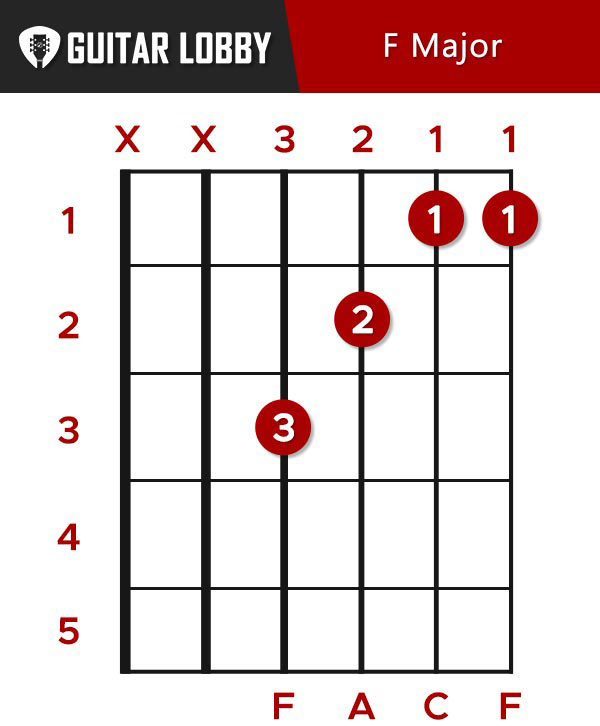
This shape is widely considered the bones F major chord. There are several similar variations, only this is one of the almost mutual and is an alteration of a barre chord where the low E and A strings are left muted making it a bit easier to play than the classic Barre chord shape. The fingering is the following:
- Barre your first finger (index) on the 1st fret of the B and high Eastward strings.
- Place your second finger (middle) on the 2d fret of the Thou string.
- Identify your tertiary finger (ring) on the 3rd fret of the D string
- Stum the four bottom strings, keeping the A and low E strings muted.
Imagine this chord as a mini barred chord, since y'all only barre the 2 bottom strings. Alternatively, you can play but the 3 lesser strings, leaving the D cord muted since the F note is repeated twice in the same chord in both the Eastward and D strings. For this item type of partial barre chord, the hand position tin exist slightly dissimilar than the strict hand position needed to play full barre chords. You can place the inner office of the manus, meaning the inner side of your thumb, rather than the tip, on the guitar neck. This position puts an angle on the fingers and makes it easier to hold the barre for the bottom two or three Fingers.
2. F Barre Chord – Root Low Eastward String
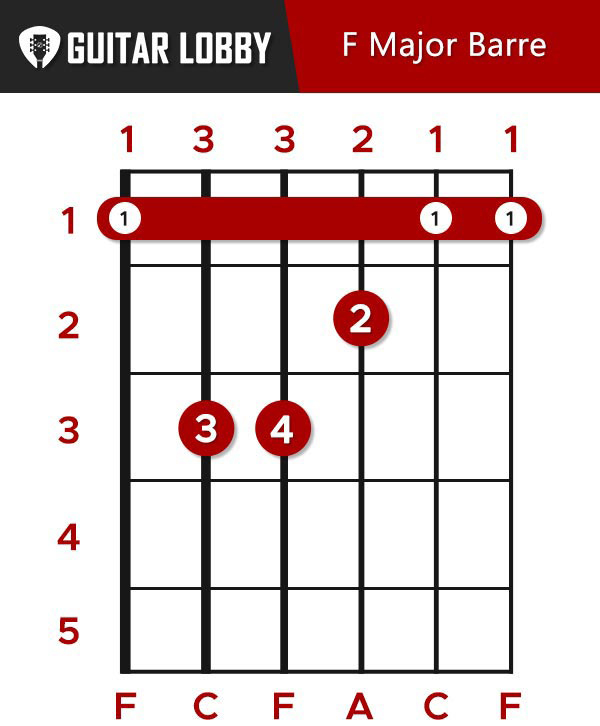
Similar to the commencement chord to a higher place, here we accept the full barre chord version of an F major chord. Barre chords can exist played in unlike positions on the fretboard using different fingering depending on the location of the root note. The first position was based with a root on the low East cord, the second with the root note on the A string.
The fingering for an F Barre chord with the root note on the low E cord is as follows:
- Barre your first finger (index) down on the 1st fret across all vi strings.
- Place your second finger (middle) on the 2d fret of the M string.
- Place your tertiary finger (ring) on the 3rd fret of the A string.
- Place your 4th finger (pinky) on the 3rd fret of the D string.
The most used position of the F chord is the classic barred chord at the 1st fret. Supposing that this is your starting time barre chord, we volition give a short insight on how a barre chord is formed and how to play it cleanly. A barre chord is a chord formed when the fingers, usually the index finger, blocks more than 1 string and acts as a guitar capo. The term barre refers to the mitt position which acts every bit a barre to act every bit if the nut has moved to a new position.
This shape can exist a fleck more challenging on your hand since the 2 fret gap between the alphabetize and middle finger is sometimes a challenge, compressing three fingers on the tenth fret can also be a chip tough at first.
Bank check out this splendid F barre chord exercise:
3. F Barre Chord – Root A String
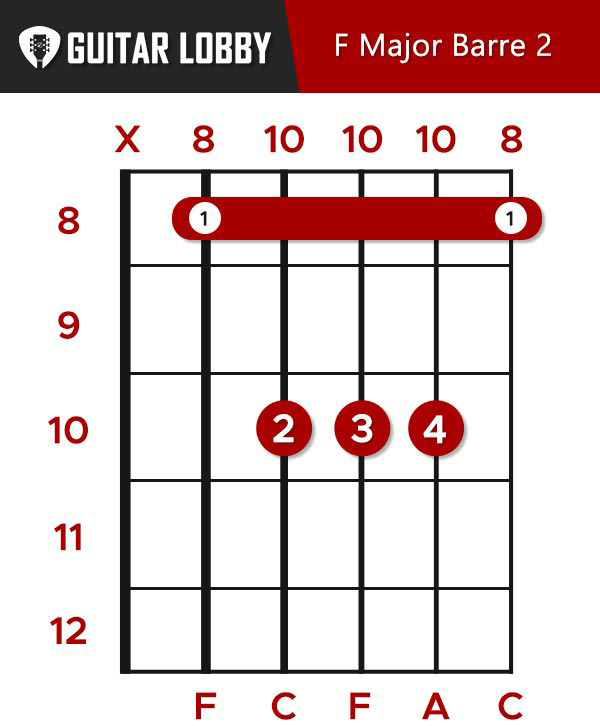
To play the F barre chord apply the following fingering
- Barre your start finger (index) on the 8th fret across the A, D, G, B, and high East strings.
- Identify your second finger (centre) on the 10th fret of the D string.
- Place your tertiary finger (ring) on the 10th fret of the G string.
- Place your fourth finger (pinky) on the tenth fret of the B string.
- Go along the low E cord muted.
Barre chords crave a different approach compared to open chords. The major difference in learning them is that barre chords tend to put some more than pressure on the paw, so they often take a bit more than practice in order for you to build up the manus dexterity and strength needed to play them properly and effortlessly incorporate them into your playing. If y'all apply the proper techniques, you lot tin can chief, barre chords in a couple of curt weeks.
four. F Barre Chord – Alternate Fingering
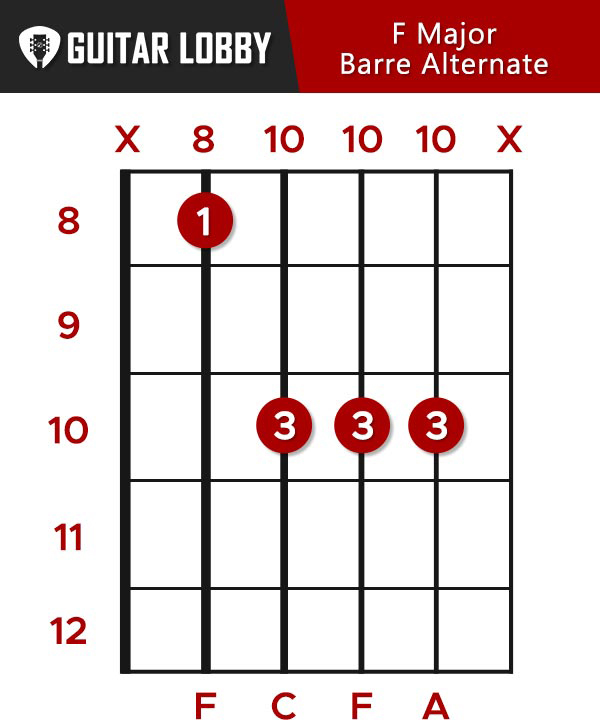
There is another fingering that uses a barre with either your pinky or your ring finger on the 8th fret. Depending on what feels best for you. This fingering tin exist mastered a bit easier for near players and will audio cracking also. It's always ideal to take a number of chord variations in your playing arsenal to help yous become a well-rounded and versatile player.
We prepared this video with a more detailed explanation of the chord fingering and general tips on getting barre chords right
(Video Coming Soon)
Tips, Tricks, and Common Challenges
Mastering the F chord means leveling upward on your chord game. You tin can so access all other barre chords positions across the neck.
Some of the most common challenges guitarists face up with the F chord are:
- Fret buzzes
- The Due east or/and B strings are non ringing at all
- I tin't position the barre well enough to comprehend all the strings
The primal to prepare virtually of these issues is focusing on your thumb positioning on the back of the neck every bit well every bit the angle your fingers are coming downward on the fretboard. Ideally, your fingers are coming straight down on the cord as to non lye on summit of other strings inadvertently.
Another technique that can help you as a beginner is practicing while belongings your guitar in the classical guitar position. This position implies holding the guitar on the left leg (right if y'all are a leftie) and pointing the guitar cervix up. In this position, your left paw is in a more advantageous position.
Expert Insight
Strum slowly and softly when first learning chords. Playing a cord with too much strength tin can change its pitch and also bring buzzes out of any guitar.
Guitars are not perfect instruments. Sometimes, strumming besides difficult on a cheap guitar can make frets fizz and bring out another issues too.
Brief Music Theory
Major chords are formed by the 1st, 3rd, and 5th intervals of the corresponding major scale.
A major scale is formed out of 7 notes, each of them corresponding to a number from 1 to 7. The distance between 2 notes, otherwise called an interval, is as well related to these numbers. So for example, the distance betwixt the 1st interval and the 4th interval is a 4th. The distance from the 1st to the 5th is chosen a 5th and and then on.
The notes of the F major scale are:
| F | G | A | B♭ | C | D | Due east |
| i | 2 | three | 4 | v | six | 7 |
Therefore, an F major chord is formed from an F, A, and C note. Chords with iii notes are also called triads.
If yous want to make the chord minor then merely lower the 3rd by a half-step. That ways move 1 fret down from an A note and play an Ab note.
6. F Major – Variation 2
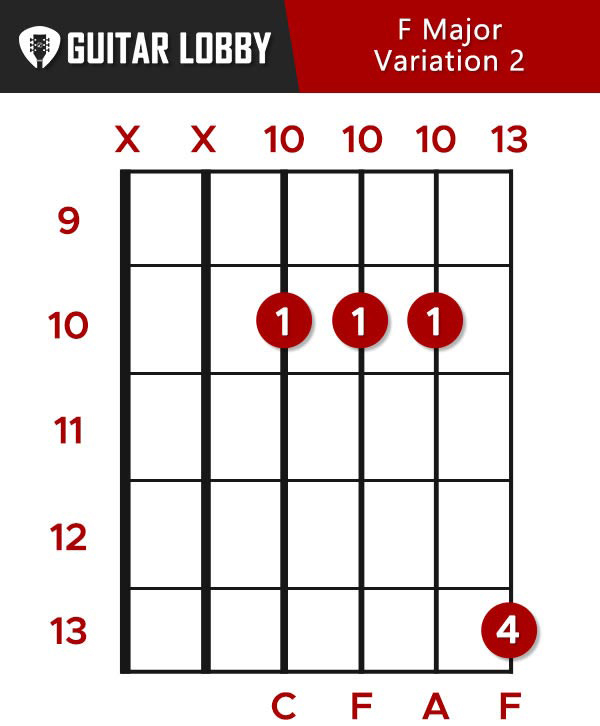
Another cool variation of the F guitar chord is based on the other F barre chord archetype shape. The fingering is the post-obit
- Identify your kickoff finger (alphabetize) as a Barre on the 10th fret of the D, G, and B strings.
- Place your 4th finger (pinky) on the 13th fret of the high East cord.
- Play the bottom four strings, keeping the depression E and A strings mute.
This chord shape adds a high F annotation to the familiar F barre chord. The F annotation on the high East gives this notation additional treble, making information technology a great idea to play this shape while jamming with some other guitarist or a bass player – it volition cut through the mix as your band makes supply the lower notes and you play the loftier for a rich full mix.
Popular Related Article: Basic Guitar Chords That Are Corking for Beginners
seven. F Major – Variation 3
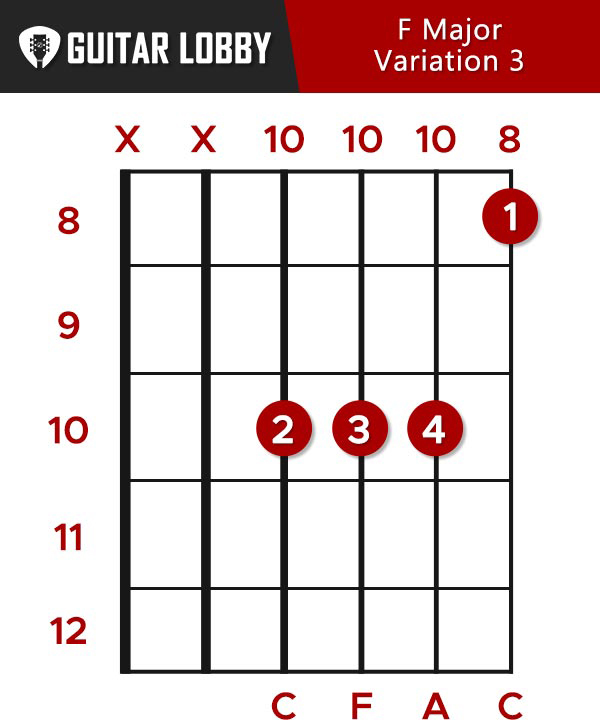
Some other variation of the F major chord takes the 3 notes from this barre chord but uses all 4 fingers. The fingering is the following
- Put your second finger (center) on the 10th fret of the D cord.
- Put your third finger (ring) on the 10th fret of the Thousand string.
- Put your fourth finger (pinky) on the tenth fret of the B cord.
- Put your first finger (index) on the 8th fret of the high E string.
- Play the bottom 4 strings, keeping the low E and A strings mute.
This chord shape is more challenging than the previous one but still is easier on the mitt than the total barre chord shapes.
8. F Major – Variation 4
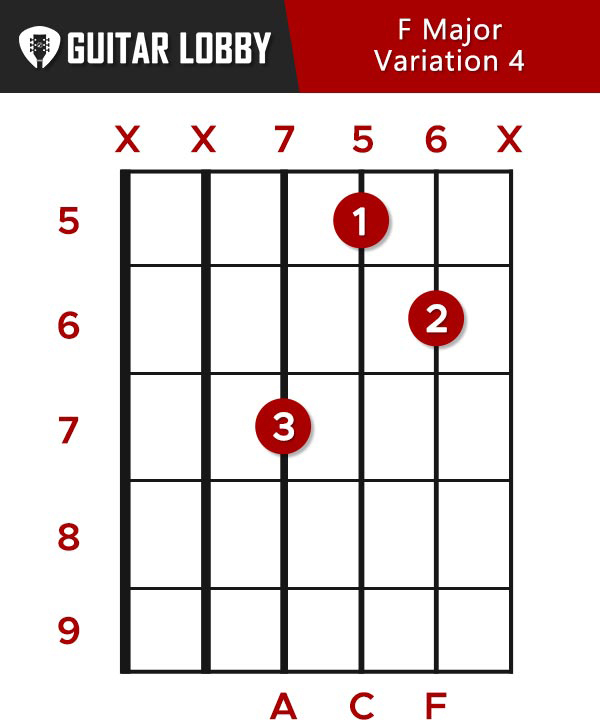
Another fashion to play the F major chord can be found in the center expanse of the fretboard. The fingering for this shape is as follows
- Put your 3rd finger (ring) on the seventh fret of the D string
- Put your outset finger (index) on the fifth fret of the G string
- Put your second finger (heart) on the sixth fret of the B cord
- Play the 3 fretted strings, keeping the high E, low E, and A strings mute.
This shape is also a triad and part of a group of chords that are called inversions. Inversions use the same iii notes equally triads but switch upwards the society of notes on the fingering.
On this item chord the note that stays on top (the height string) in the A note, or the 3rd of the chord.
Careful on not accidentally strumming the loftier E string. Remember that half stride rubs (when you play a note half stride lower or higher than the chord root) can sound very crude on the ear.
9. F Major – Variation 5
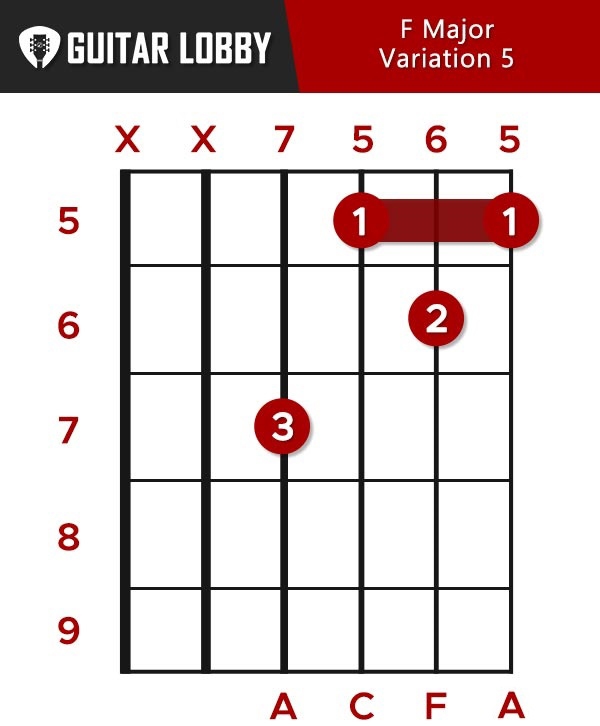
This shape can also be played with a barre on the 5th fret of the G, B, and high E cord. The other fingers stay in their original place simply y'all can also add the East string now (since information technology frets and A notation, part of the F major chord) to the chord and strum all four bottom strings.
Practiced Insight
Knowing which strings to mute, and learning how to do so effectively, is very important when playing chords. Knowing how to not play the wrong notes makes all the difference between a good and bad-sounding chord.
Muting is very hard to teach and is a skill that naturally develops in guitar players in different forms. As long as you know that a certain string should not ring, use some basic muting concepts and the remainder will develop in fourth dimension.
ten. CAGED F Major Chords
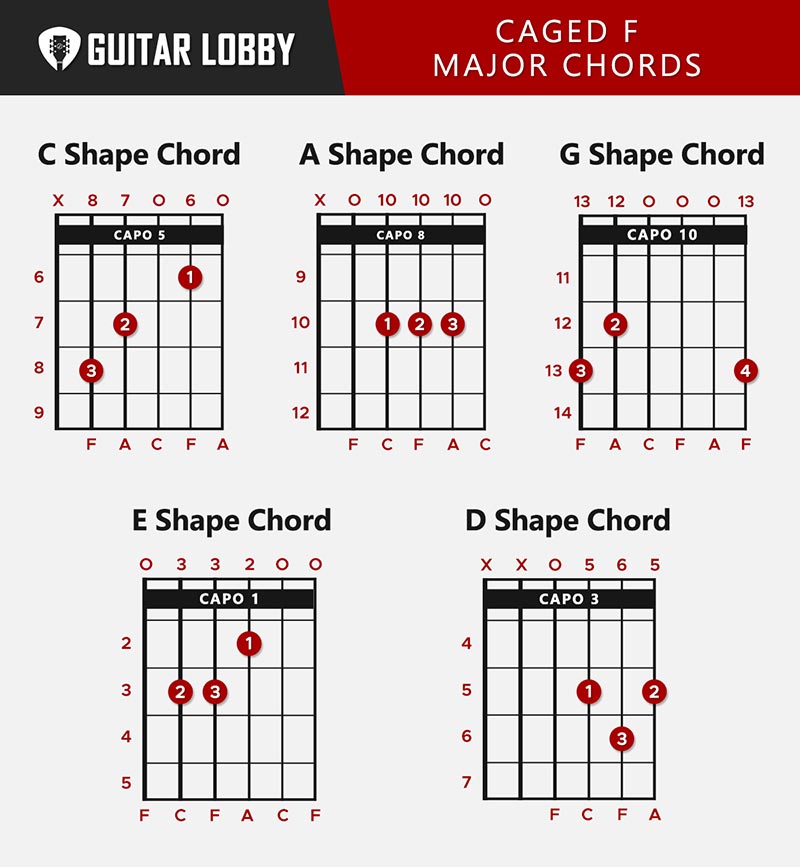
The CAGED organisation is a very popular manner of organizing the fretboard. The system states that all chords tin can be played in v different shapes on the whole fretboard.
The shapes are the open up chord shapes of the C, A, Thou, E, and D chords. Moving these shapes up and down the neck while changing the root note to the chord you are aiming for is the fundamental to this organization. So simply put, you can play an F chord in these five different shapes, by moving east basic shape to the proper position on the fretboard.
On the chord nautical chart to a higher place, you can find all the CAGED chord shapes of the F major chord. Every bit you tin notice some of the shapes are the ones we already covered. A skilful fashion to understand CAGED chords is to take the offset F major barre chord shape as an example.
Play a standard East major open up chord first, now move the exact shape y'all are fingering ane fret up. At present place the barre on the 1st fret of all six strings and imagine it in the role of the guitar nut. What you lot go is the F major chord, which is naught more than than an E major shape moved upward 1 fret.
Another dandy F Major CAGED chord is based on the C chord shape. Start by playing a C major open chord. Now if nosotros place a capo on the 5th fret, making that our new nut location, and play the C chord shape on the sixth, 7th, and 8th frets, we accept an F major chord.
Cheque out this video for a more detailed insight into the F major CAGED chords.
(Video Coming Shortly)
11. F7 Chord – F Dejection Chord
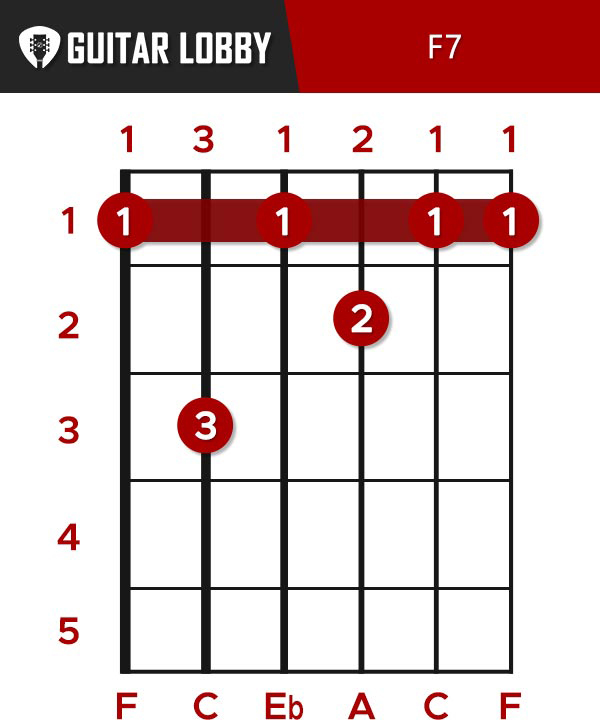
Fundamental to blues guitar are 7th chords. A 7th chord is nothing more than a standard major chord with the added interval. And then the formula becomes 1st, third, 5th, and 7th. In the F major scale, the 7th interval is the Eb annotation. Therefore and F7 is an F Major plus and Eb note.
- Barre your first finger (index) on the 1st fret across all vi strings.
- Place your second finger (middle) on the 2ns fret of the G cord.
- Place your third finger (ring) on the 3rd fret of the A cord.
12. F7 – Alternative
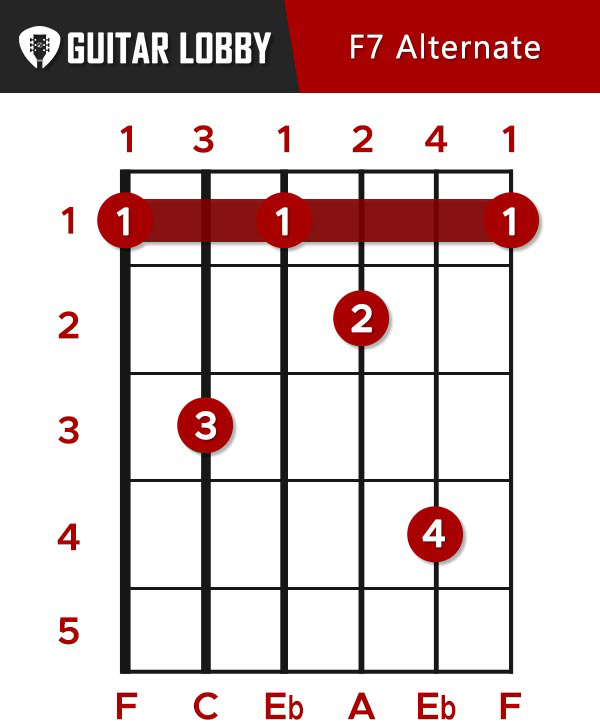
Alternatively, you tin also play the chord this fashion with an extra Eb note. This chord is a bit challenging only add together a different dynamic to your playing if you tin nail information technology.
- Barre your first finger (index) on the 1st fret beyond all 6 strings.
- Place your second finger (centre) on the 2ns fret of the G string.
- Identify your third finger (ring) on the 3rd fret of the A string.
- Place your fourth finger (pinky) on the 4th fret of the B string.
More details on these 2 F7 chord shapes on this video
(Video Coming Soon)
Expert Insight
Try out the 12 bar blues progression when practicing these chords. The F 12 bar blues progression uses the 1st, fourth, and 5th chord of the F Major key. Same numbers and notes that stand for to the notes in the F scale: F, Bb, and C.
To play the 12 bar blues in F you lot should only play the F7, Bb7, and C7 chords. If yous don't know how to play the other chords you tin learn them on our site.
13. F Power Chord – Root Low E String
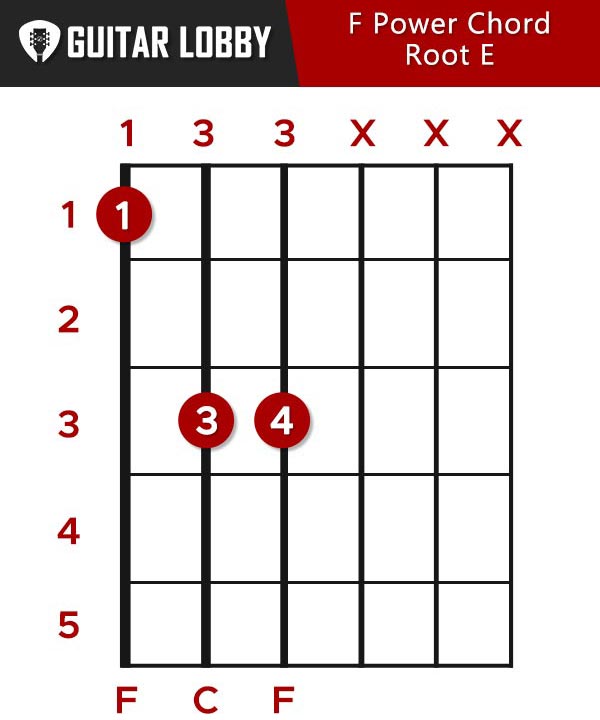
The fingering for the F power chord is the following
- Identify your offset finger (index) on the 1st fret of the low E string.
- Place your third finger (ring) on the third fret of the A string.
- Place your fourth finger (pinky) on the 3rd fret of the D string.
fourteen. F Ability Chord – Root A String
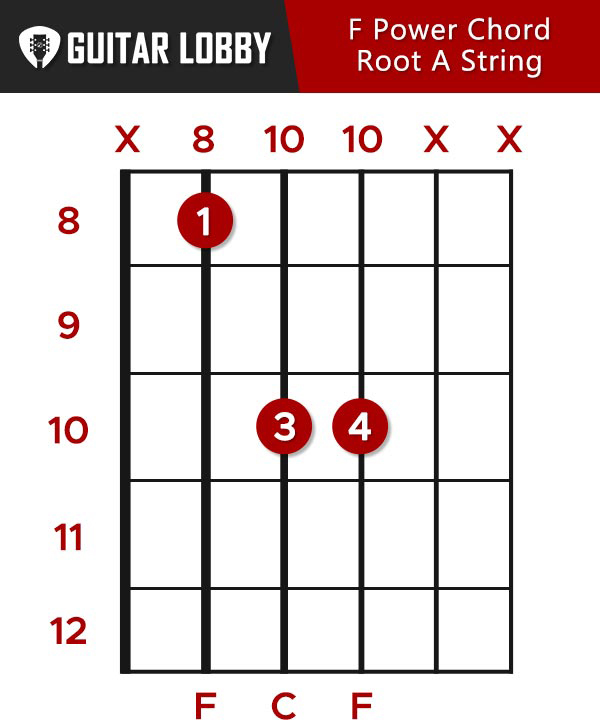
An alternate way of playing the F power chords is to base of operations it on the other shape of the F barre chord.
- Place your first finger (index) on the eighth fret of the A string.
- Place your third finger (ring) on the tenth fret of the D string.
- Identify your fourth finger (pinky) on the 10th fret of the G string.
Ability chords are made up of only the 1st and 5th intervals. Since there is non the 3rd interval, the chord is neither minor nor major. That ways you can safely utilise information technology in both situations.
Playing F Chord on Electric Guitar
The electric guitar oftentimes requires a bit of a different approach for the F major chord to sound ideal. Go on in listen that the classic audio-visual guitar cowboy chord (some other name for open chords) in most cases sounds too dirty or chaotic on electric guitar, fifty-fifty with a clean tone in many situations.
When playing with a clean tone on an electric guitar, endeavor to approach strumming in a more gentle, or more detailed manner. Combine right-paw dynamic (playing difficult and soft) with arpeggios and strumming of simply part of the chord.
Another great tip is to avoid playing the bass notes when you are playing with a bass actor in a ring. You can endeavor out some of the F guitar chord variations demonstrated in the previous section that avoid the notes on the E and A strings.
Power chords, or otherwise called 5th chords, are widely used in rock and metallic music. There are few sounds in all of music more iconic than a distorted power chord. From rock north' roll to classic stone and metallic, ability chords accept defined the sound of the genres and many sub-genres.
To grasp the concept of power chords apace, recall of them equally the upper part of your barre chord and only use the Low E, A, D, and sometimes Thousand chord.
Final Tips on Playing the E Major chord
Utilise a metronome. Try to place it on a slow count, about 70bpm, and play the F major downstroke once per click. And so offset slowly adding upstrokes in between the click and go on practicing being on time with the beat. It might be a flake challenging at first just the payoff is huge for both rhythm and atomic number 82 playing.
Left-mitt muting. While property the F barre chord on the 8th fret of the A string there is a fashion to mute the low E cord from ringing. Touch information technology slightly with the tip of your index finger that is playing a note on the A cord. That assures the string doesn't band if you happen to strum information technology with your right hand. You can utilize the aforementioned concept to all the strings and chord shapes that need muting.
Try the 1-minute changes exercise. Set a timer to 60 seconds and cull 3 or 4 chords. Now, at whatever tempo yous are comfy with, play the chords in a rhythm while focusing on playing make clean chords with smooth changes. Practice this for at to the lowest degree 1 minute at a time. Repeat this process and do this every 24-hour interval for thirty days and track your progress.
If you establish this article helpful, be certain to check out our other articles for other major chords A Chord Guitar, B Chord Guitar, C Chord Guitar, D Chord Guitar, Eastward Chord Guitar, and G Chord.

My name is Chris and I've had a passion for music and guitars for as long equally I tin remember. I started this website with some of my friends who are musicians, music teachers, gear heads, and music enthusiasts so we could provide loftier-quality guitar and music-related content.
I've been playing guitar since I was 13 years old and am an avid collector. Amps, pedals, guitars, bass, drums, microphones, studio, and recording gear, I love it all.
I was born and raised in Western Pennsylvania. My groundwork is in Electric Engineering, earning a Bachelor's degree from Youngstown State University. With my engineering experience, I've developed every bit a designer of guitar amplifiers and effects. A true passion of mine, I've designed, congenital, and repaired a wide range of guitar amps and electronics. Hither at the Guitar Foyer, our aim is to share our passion for Music and gear with the residue of the music community.

How To Play An F Chord Guitar,
Source: https://www.guitarlobby.com/f-guitar-chord/
Posted by: gonzalesmiled1958.blogspot.com
0 Response to "How To Play An F Chord Guitar"
Post a Comment